What is the lowest-risk path to scaling multilingual access across your organisation without blowing up security, budget, or user experience?
This question is asked by thousands of leaders every day. The first thing to consider is that global communication has never been more complex. Enterprises and institutions now operate across markets and time zones, manage remote teams and virtual events, and engage audiences who speak dozens of different languages.
With this global reach comes a growing responsibility: to ensure that every stakeholder can understand, contribute, and feel included. For decades, this responsibility was handled by human interpreters working on site with hardware booths and headsets. Today, artificial intelligence can translate speech in real time and generate captions at a fraction of the cost, while hybrid platforms offer the flexibility to combine both approaches.
But choice brings confusion. Leaders, teams, and event organisers must select the right solution for their needs while balancing accuracy, scale, security, and cost. To help you navigate this decision, we have gathered up-to-date information on the language solutions available in 2026, including human, AI, and hybrid systems, leading providers, and the key factors to consider when going multilingual.
In this article
- Understanding What You Need To Consider Before Selecting A Language Partner
- Type of content and context
- Number of languages and combinations needed.
- Accuracy and nuance
- Latency and scale
- Security and compliance
- Integration and workflow
- Cost and scalability
- How To Choose A Language Provider According To Your Use Case?
- The Language Partners And Providers Landscape Explained
- Conclusion
Understanding What You Need To Consider Before Selecting A Language Partner
Before short‑listing language partners, providers or vendors, take time to assess your organisation’s needs. Here are factors to evaluate:
1. Type of content and context. Sensitive negotiations, high‑stakes legal matters or complex stakeholder discussions require experienced interpreters who can convey nuance and maintain confidentiality. For training sessions or internal all‑hands meetings, AI speech translation may be sufficient and more scalable.
2. Number of languages and combinations needed. Some solutions handle a handful of languages, while others cover thousands of language combinations. It is important to know which languages you need before you even start searching for a language partner. For example, if you require low-resource language combinations such as French-Swahili, verify that the provider can reliably deliver them.
3. Accuracy and nuance. Human interpreters can make mistakes, but they have consistently proven to understand idioms, sarcasm, and cultural references faster and in greater depth than AI. AI translation, nonetheless, has improved dramatically, although it still struggles with context and industry-specific jargon. Before deciding which option to invest in, it is paramount to determine whether you only need general understanding or whether mistakes could be costly. You should also evaluate how language providers train their AI to recognise the terminology, names, and expressions you will use, and whether the interpreters provided are properly vetted specialists or generalists with limited domain expertise.
4. Latency and scale. This category applies primarily to AI speech translation and live captions. But what is latency? It refers to the time delay between when someone speaks and when the translated speech or text is delivered in another language. Latency can be difficult to measure precisely, but during a demo you should pay close attention to how quickly the AI engine responds. You should also look for glitches or interruptions, as both can make a significant difference in a live meeting or event. Scale, on the other hand, relates to how many languages an AI speech translation solution can support at the same time. When evaluating language partners, prioritise solutions that can comfortably scale to your current language needs while allowing room for future growth, without compromising performance or user experience.
5. Security and compliance. Enterprise data must be protected, and compliance should never be an afterthought when selecting a language partner. It is important to understand how providers handle data encryption, access controls, and data retention, especially when meetings involve sensitive or personal information. Certifications such as ISO 27001 and compliance with GDPR are strong indicators of mature security and privacy practices and provide reassurance that your multilingual communications can scale safely over time. For the specific questions to ask, see What Security Standards Should Automatic Speech Translation Meet? and our contract-ready checklist.
6. Integration and workflow. Many language providers operate as standalone platforms or applications, while others integrate directly with tools such as Zoom, Microsoft Teams, or event management systems. Some solutions combine all of the above and offer multiple integration and access options, allowing participants to join in different ways depending on the event setup. This flexibility reduces friction for users, simplifies internal workflows, and makes it easier to operate effectively today while scaling multilingual access in the future. When deciding, it is worth asking yourself: why limit your options?
7. Cost and scalability. On-site human interpretation often involves day rates plus travel and accommodation, without necessarily delivering better results for live events than online simultaneous interpretation. In many cases, the same level of quality can be achieved through a remote platform, provided it is designed specifically for interpreters and gives them the tools they need to perform at their best. Selecting the right online platform can significantly reduce costs while maintaining quality, creating a clear win-win scenario. When choosing a language partner, make sure their platform is built with interpreters in mind and that their AI services are reliable, redundant, and secure. After all, why choose one or the other when a future-proof language partner can offer both?

How To Choose A Language Provider According To Your Use Case?
Now let´s dive deeper in four different use cases for the different language access options in the market in 2026.
Use Case 1: Executive Board Meetings Or Legal Proceedings
These sessions require discretion, confidentiality, and the ability to interpret nuance. Because they usually involve a limited number of participants, professional interpreters remain the best option. The challenge is accessing the right interpreters without overspending while maintaining consistent quality. A high-quality remote simultaneous interpretation platform allows vetted interpreters to join through secure channels, ensuring confidentiality and accurate messaging. For added accessibility, combining human interpretation with AI-powered captions can also provide real-time transcripts for hearing-impaired participants.
Read how Syntax uses our solutions
Use Case 2: Town‑Hall Meetings And Training Sessions
In this case, the main goal is clarity. For internal exchanges, budgets are often limited, but that does not mean language access should be compromised. AI speech-to-speech translation and AI-powered captions can help ensure teams do not feel excluded. These tools work particularly well for webinars, recorded content, and e-learning modules, where minor translation imperfections are unlikely to have legal or operational consequences.
Read how The Super Patch Company used our solutions
Use Case 3: Customer Support Or Sales Calls
Customer support and sales conversations rely on speed, accuracy, and natural interaction. These exchanges are often one to one or involve small groups, and even short delays or misunderstandings can affect trust and outcomes. In many cases, AI-powered speech translation can support real-time communication and help teams respond quickly across language barriers. For higher-value conversations or complex products, having access to human interpreters, either on demand or as a fallback, can ensure clarity, reduce risk, and maintain a professional customer experience.
Use Case 4: Hybrid and Virtual Conferences
Hybrid and virtual conferences bring together in-person and remote audiences, often across multiple regions and time zones. These events typically involve large numbers of participants, diverse language needs, and a mix of high- and low-priority sessions. A hybrid approach works well in this context, using professional interpreters for keynote sessions or strategic discussions, while relying on AI speech translation or live captions for breakout sessions and less common languages. The key is to provide a consistent and easy-to-use experience for all attendees, with clear audio, minimal delay, and flexible access across devices and platforms.
Read how UEFA used our solutions
If your specific scenario does not fit neatly into any of these use cases, you are not alone. Many organisations operate in dynamic environments where communication formats, audiences, and risk levels change frequently. In these situations, flexibility becomes more important than choosing a single fixed solution. A language partner that offers both human and AI options allows you to adapt to different meetings, audiences, and budgets without rethinking your setup each time. Rather than forcing your needs into a predefined category, look for a solution that can evolve with your organisation and support a wide range of multilingual communication needs.
The Language Partners And Providers Landscape Explained
Once you have evaluated your needs, the next step is to assess the language partners that can support them. This is often easier said than done. The market is crowded, documentation is lengthy, and many solutions sound similar at first glance. It is easy to lose track of which provider supports which capabilities, or where you read about a platform that claimed to cover thousands of language combinations.
To simplify this process, we have brought together a clear overview of the leading options in the language technology market. Rather than focusing on traditional language service providers, this section looks at companies that build and operate the technology behind multilingual communication. These platforms enable live interpretation, AI-powered speech translation, captions, or hybrid solutions designed for meetings, events, and ongoing enterprise communication. The goal is not to recommend a single “best” option, but to help you understand how different approaches compare and which types of solutions may be the best fit for your organisation.
Leading Options In The Language Technology Market (Not including Interprefy)
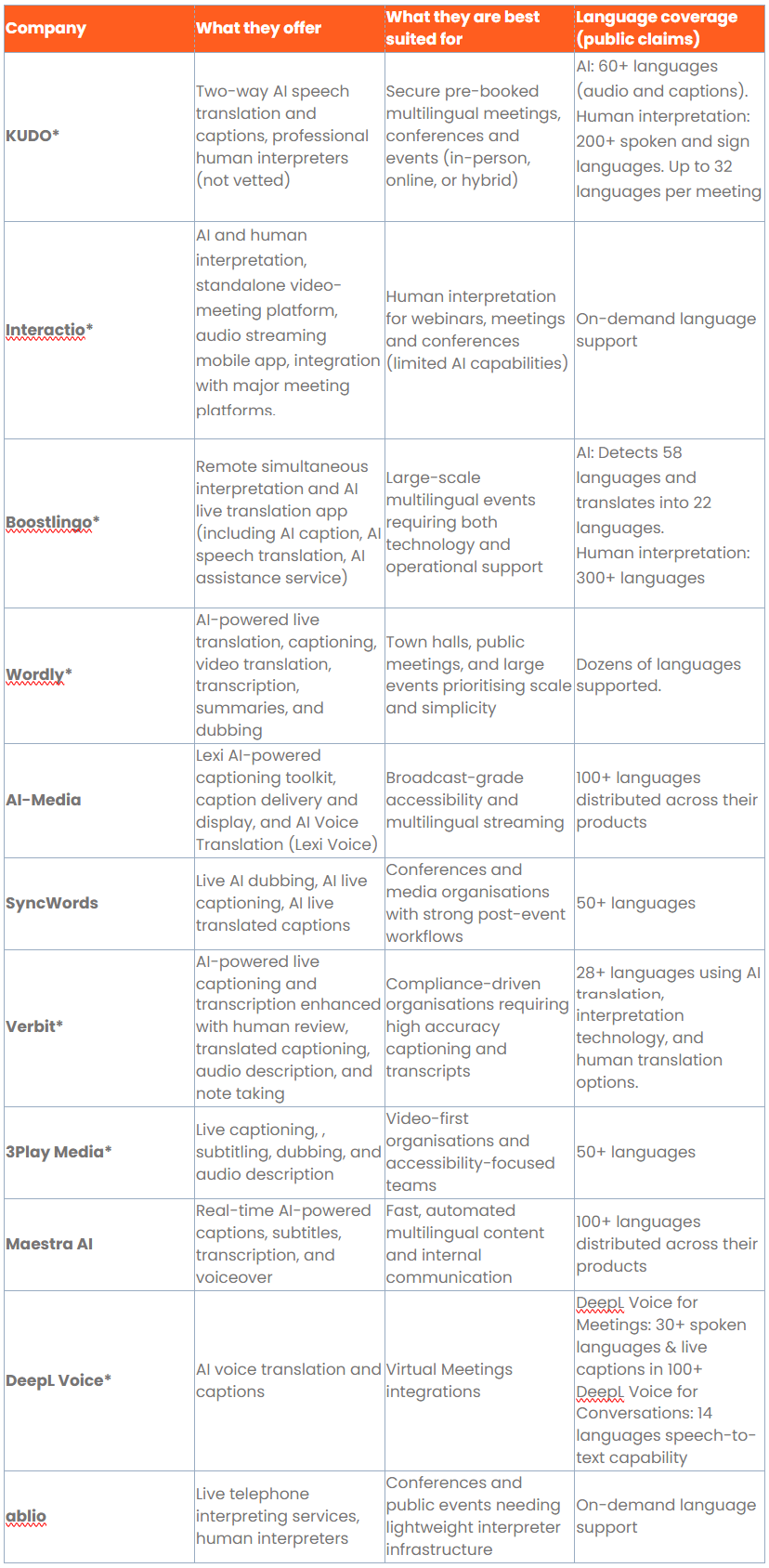
* Has a mobile app
If you’re choosing a solution for a specific event rather than an organisation-wide strategy, our live translation decision framework for event organisers walks through the choice step by step, and our round-up of the best live translation apps for events compares the main tools side by side.How Interprefy Fits Into a Multilingual Communication Strategy
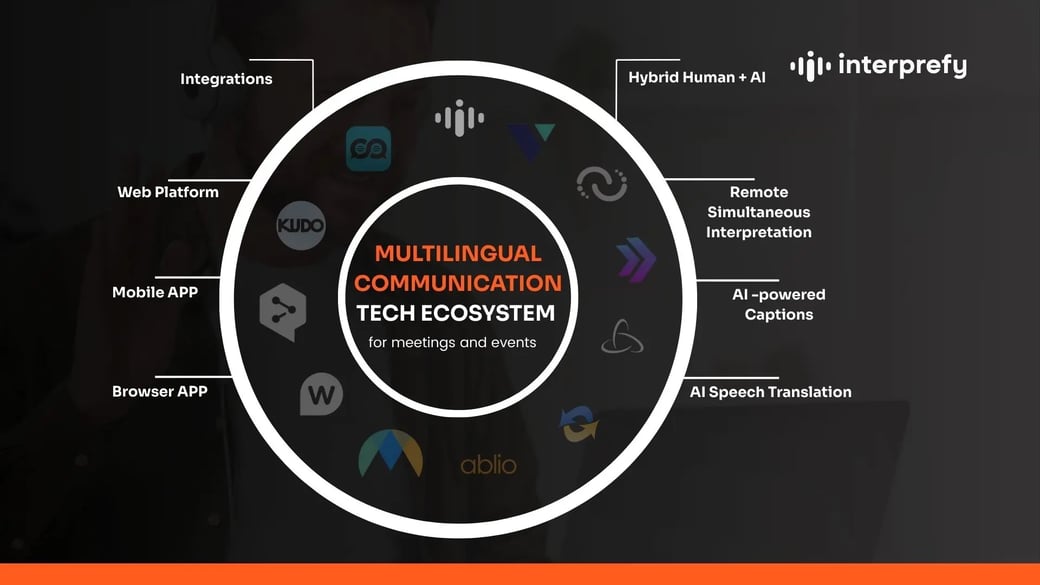
Interprefy operates as a multilingual communication partner, offering remote simultaneous interpretation, AI speech translation, and live captions in over 6000 language combinations. These services are available separately or in combination, allowing organisers to select the appropriate setup based on the context, audience, budget, and communication requirements.
Language access is delivered through Participants can join through the Interprefy web platform, the mobile app, or the meeting platform they already use. This allows participants to join from different devices and environments while maintaining a consistent experience across virtual, hybrid, and in-person formats. For organisations that run meetings on Microsoft Teams, Zoom or Google Meet, Interprefy Agent joins the call like any other participant and delivers AI speech translation without changing how teams already meet.
Depending on organisational preferences, arrangements can be managed independently or supported by Interprefy's professional services team. These services include orientation, project management, remote technical support, and media services for evergreen or recorded content. Clients may choose to use some, all, or none of these services, depending on internal capabilities and the complexity of the meeting or event.
For organisations running recurring meetings or event series, Interprefy offers yearly plans that provide a familiar and repeatable process over a defined period. These plans are designed to support consistency across events and can be adjusted or discontinued based on changing needs, rather than locking organisations into a fixed long-term model.
Across these use cases, Interprefy is designed to operate in a flexible, secure, and resilient manner, supporting different communication formats and operational approaches as organisational requirements evolve.
When Interprefy Might Be The Best Fit
Interprefy may be an appropriate option for enterprises that manage multilingual communication across multiple teams, regions, or formats and require a structured yet adaptable approach. This includes organisations that need to support different language access models depending on the meeting type, audience, or level of sensitivity, without introducing separate tools or vendors. It is also relevant in environments where multilingual communication spans broadcasts or virtual, hybrid, and in-person settings and where governance, security, and operational consistency are important. Enterprises with recurring meetings or event programmes may consider Interprefy when a repeatable process is needed over time, while retaining the flexibility to adjust configurations or scale language access as organisational needs change.
Conclusion
The lowest-risk path to scaling multilingual access is not to standardise on a single technology or delivery model, but to standardise on an approach. Organisations that succeed treat language access as an ongoing capability rather than a one-off service, and make deliberate choices based on context, risk, and audience rather than convenience alone.
In practice, this means choosing a language partner that allows your organisation to combine different forms of language support. Human interpretation remains essential where accuracy, accountability, and nuance matter. AI speech translation and live captions provide scale and cost efficiency for internal communication, training, and large audiences where minor imperfections are acceptable. Using these options selectively, rather than exclusively, reduces both operational risk and unnecessary spend.
Risk is further reduced when multilingual communication is integrated into existing workflows and governed consistently across meetings and events. Solutions that work across virtual, hybrid, and in-person formats, and that allow organisations to adapt language access over time, help avoid fragmentation and user friction. Predictable cost structures and repeatable processes also play an important role in keeping multilingual access sustainable as usage grows.
Ultimately, scaling multilingual access safely is less about choosing the “best” tool and more about maintaining flexibility, governance, and clarity of intent. Organisations that build their language strategy around these principles are better positioned to expand globally without compromising security, budget control, or the experience of the people they are trying to reach.



 Download from the App Store
 Download from Google Play
 More download links