.webp?width=1040&height=800&name=Interprefy_Multilingual%20Technology%20Supports%20Every%20Use%20Case%20(1).webp)
Organisations from all over the world are starting to rethink how they communicate internally and externally. Multilingual technology is emerging as a strategic capability, not simply a tool for major conferences. Interprefy’s latest market research across APAC and the Middle East shows that demand for real-time multilingual support continues to rise, with 86% of Middle Eastern organisers and 71% of APAC organisers identifying strong attendee expectations for live translation and interpretation at events of every type and format.
But some of the most significant opportunities lie outside the traditional events space. As your organisation - whether a company, enterprise, government body, or NGO - expands across regions, restructure teams, and engage increasingly diverse stakeholders, the ability to provide accurate, secure and scalable multilingual communication is becoming central to operational excellence.
Here are five strategic use cases where multilingual technologies; such as Remote Simultaneous Interpretation (RSI), AI-powered speech translation and live captioning, deliver measurable value beyond the conference hall.
1. Company-Wide Meetings That Strengthen Global Culture
Town halls, kick-offs, quarterly briefings and all-hands meetings play a vital role in shaping culture, reinforcing strategy and building trust. Yet organisations frequently overlook the linguistic diversity within their own workforce.
The Interprefy market report highlights that over half of Middle Eastern organisers (56%) see clear benefits in adding multilingual support to company-wide sessions. This reflects a shift in expectations: employees want clarity, not approximation, when leadership communicates priorities or organisational change.
Providing real-time multilingual access ensures teams can process information in the language they feel most confident in — a critical factor in comprehension and response time. When employees understand not just what is said, but the nuance behind it, engagement increases.
For globally distributed workforces, multilingual support also prevents a common pitfall: English-dominant leadership communication that unintentionally sidelines regional teams. Instead, organisations can foster a culture where contribution is accessible to all.
2. High-Stakes Internal Business Meetings
From product launches to budget reviews, internal meetings increasingly require stakeholders from multiple regions to align quickly. Yet the report shows that 58% of APAC organisers believe their internal business meetings would benefit from multilingual services.
This is particularly important when discussions involve sensitive content, technical information or compliance-related decisions. While AI-generated captions offer speed and scalability, accuracy and contextual understanding remain concerns for many decision-makers — 55% in the Middle East and 47% in APAC cite accuracy of AI-generated captions as the top barrier to adoption.
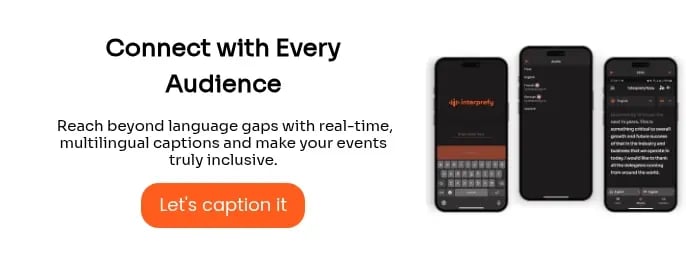
This is where hybrid solutions - AI for speed and professional interpreters for nuance - unlock value. Organisations can tailor the approach to the nature of the meeting: AI captions for broad internal updates; interpreters for contract negotiations, M&A discussions or strategic planning.
The outcome is not simply clearer communication: it’s reduced risk. Misinterpretations in internal meetings can lead to costly delays or compliance issues. Multilingual support ensures all stakeholders operate with the same level of understanding.
3. Webinars and Digital Learning Programmes
Webinars remain one of the fastest-growing formats for external engagement. Interprefy’s research reveals that 63% of Middle Eastern organisers already see strong opportunities for multilingual support in webinars.
In an era where global marketing and thought leadership strategies depend on wide reach, adding real-time interpretation or multilingual captions transforms a single-market webinar into a multi-market asset.
Similarly, learning and development teams increasingly deliver training at scale across regions. When staff can follow training in their preferred language — via audio interpretation or same-language closed captions — retention improves and cognitive load decreases.
With regulations such as the European Accessibility Act (EAA) now in effect, there is growing global emphasis on digital accessibility for multinational organisations. As a result, captioning technology is becoming a foundational requirement rather than an optional enhancement.
Related Company News:
Interprefy Launches the First Live Translation Agent for Online Meetings
4. Hybrid and Virtual Corporate Events With Global Audiences
Hybrid events have shifted audience expectations permanently. Attendees no longer tolerate experiences where multilingual support is inconsistent between online and in-person formats.
Yet the adoption gap outlined in the research is significant: 63% of APAC organisers report not using RSI for large business events, and 40% of Middle Eastern organisers also do not employ RSI for major conferences or trade shows.
This gap represents an opportunity to create a competitive edge. Organisations that invest in multilingual accessibility can attract broader participation, secure higher engagement and improve satisfaction scores.
Beyond the event itself, multilingual caption files and transcripts transform video content into a searchable, reusable asset — supporting post-event content strategies, indexing, and training use cases. AI-powered captioning also scales effortlessly across languages, offering far greater content longevity.
Related Article:
How AI Is Transforming Event Documentation: Interprefy Enhanced Transcripts
5. Confidential or Regulated Meetings Requiring Secure Multilingual Communication
Whether discussing financial results, intellectual property, or sensitive geopolitical topics, multilingual communication must be both accurate and secure.
Security concerns are growing: 49% of Middle Eastern organisers and 41% of APAC organisers worry about confidential data being processed or stored by AI systems.
This makes vendor selection critical. With platforms such as Interprefy - ISO 27001 certified and using WebRTC encrypted streaming with no-data-storage policies - organisations can protect highly sensitive content while still delivering real-time multilingual access.
As cross-border teams collaborate more frequently, secure interpretation becomes an operational necessity — not only for compliance but for preserving trust among senior stakeholders.
Looking Ahead: Multilingual Tech as a Strategic Advantage
Interprefy’s research confirms a clear trend: multilingual capability is becoming embedded in organisational infrastructure, not just event planning. Attendees, clients, stakeholders, and employees alike expect communication they can fully understand and respond to, regardless of the language spoken.
However, awareness gaps remain. Almost half of APAC Middle Eastern organisers surveyed are still unfamiliar with core solutions like RSI and live captions.
For organisations willing to lead rather than follow, this presents an opportunity to differentiate, improve accessibility, and raise the standard of communication across every interaction — not only flagship events.
Thoughtful adoption of multilingual technology enables organisations to operate with clarity, inclusivity and confidence on a global stage. And as AI and human interpretation continue to evolve side by side, the scope of use cases will only expand.



 Download from the App Store
 Download from Google Play
 More download links