
By the time a language services contract lands on your desk for signature, trust has usually already been talked about at length. What it hasn't been is written down. A sales conversation can promise reliability, security and quality, but a contract only protects you against the commitments that are actually documented, measured and enforceable. If you are choosing an interpretation partner for high-stakes meetings, conferences or institutional programmes, the question is not whether the vendor sounds trustworthy. It is whether that trust survives being turned into contract language.
This checklist sets out the areas where trust needs to move from a claim into a clause: data security, interpreter vetting, service levels, business continuity and independent validation. Each section covers what to ask for and why it belongs in the contract rather than the pitch deck.
Why Trust Is a Contract Issue, Not Just a Sales Pitch
Procurement teams are used to evaluating price and functionality. Trust is harder to price, so it often gets treated as a soft factor, something you sense from a demo or a reference call rather than something you negotiate. That approach works until something goes wrong: a data breach during a confidential board meeting, an interpreter who was not qualified for a technical subject, or a platform outage mid-session with no fallback plan. In each case, the difference between a vendor who handles the situation well and one who does not usually comes down to what was specified in the contract beforehand. Treating trust as a procurement requirement, with named standards and measurable commitments, is what separates a resilient partnership from an expensive assumption.
Data Security and Compliance Guarantees
Any vendor handling live audio, video or transcripts from your meetings is handling sensitive material, whether that is boardroom strategy, patient information or diplomatic proceedings. Before signing, ask the vendor to confirm, in writing:
- Independently audited certification, such as ISO 27001, rather than a general claim of "enterprise-grade security"
- Encryption standards for data in transit and at rest, ideally AES 256-bit with TLS and SRTP for live streams
- Data residency options that meet your regulatory obligations, including GDPR compliance and EU-based hosting where required
- A schedule of penetration testing and vulnerability assessments carried out by independent third parties, not just internal reviews
These are not features to admire on a website. They are commitments that should be referenced directly in the contract, with the right to request audit evidence on an ongoing basis rather than only at onboarding.
Interpreter Quality and Vetting Standards
When human interpretation is involved, the technology only carries the message. The interpreter delivers it, and that is where quality often breaks down invisibly, since a poor interpretation can sound fluent while still being inaccurate. A contract-ready vendor should be able to describe, specifically, how interpreters are sourced and tested: accreditation against recognised professional standards such as those set by AIIC, verification of subject-matter competence for technical, legal or medical content, and confidentiality agreements signed by interpreters themselves, not just by the vendor as a corporate entity. Ask what happens when an interpreter is unavailable at short notice, and whether backup interpreters are vetted to the same standard or brought in as a lower-cost substitute. If the vendor cannot answer these questions with specifics, that absence of detail is itself useful information.
AI Speech Translation and Live Caption Accuracy
Many organisations now rely on a mix of human interpreters, AI speech translation and live captioning, sometimes within the same event. AI introduces its own trust questions, and a vendor who is transparent about them is more trustworthy than one who blurs the line between human and machine output. Ask the vendor to specify accuracy benchmarks for their speech recognition and machine translation engines, ideally by language pair, since performance varies significantly across languages and accents. Confirm whether captions and AI-translated audio are clearly labelled as machine-generated, and whether a human interpreter can be brought in as a fallback for higher-stakes segments of an event. Also establish whether your audio, video or transcripts are used to train the vendor's AI models, or whether they are processed solely to deliver the service and then deleted. That distinction should be stated explicitly in the contract, not left to a general privacy policy.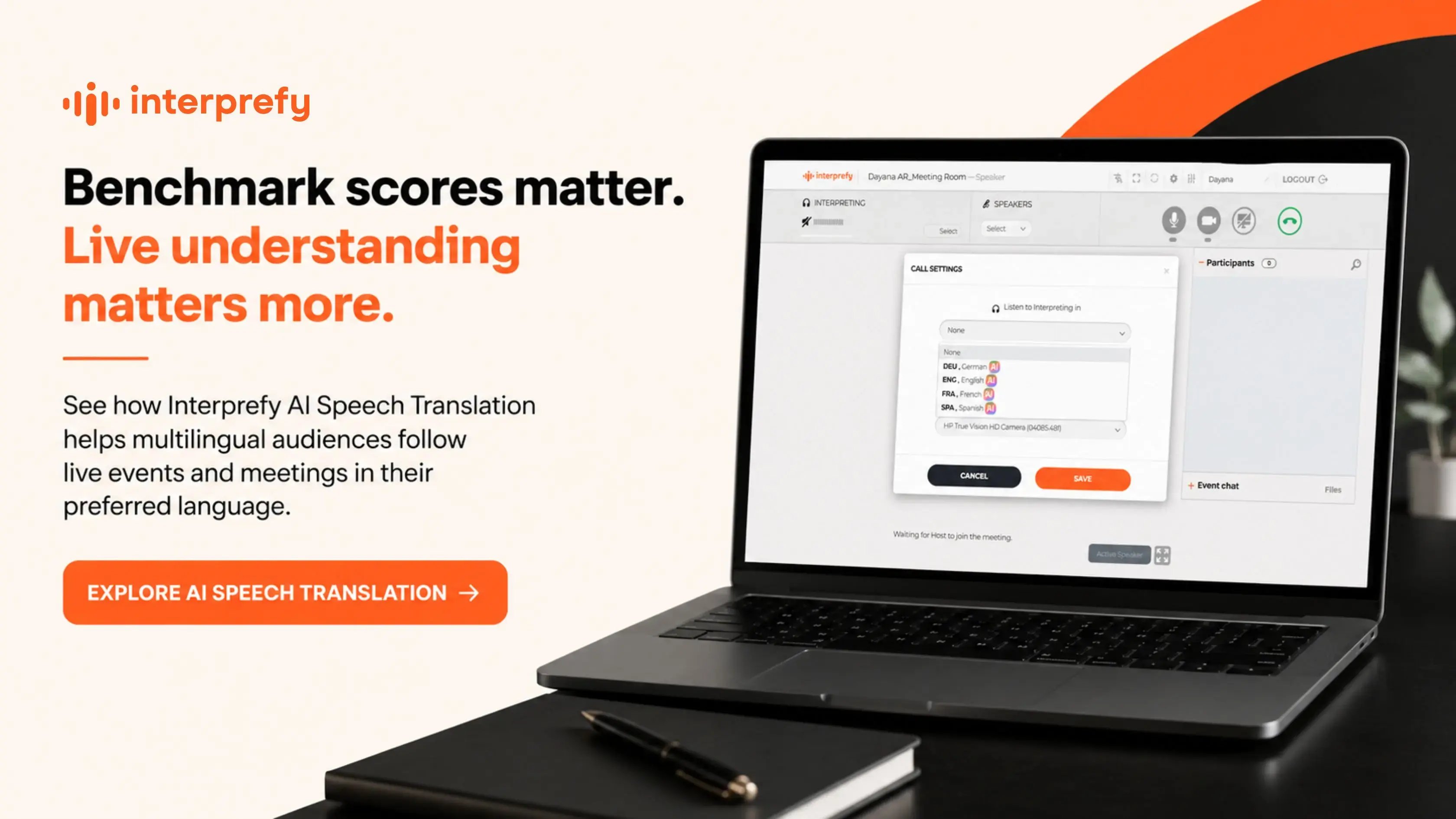
Service Level Agreements and Uptime Guarantees
For live, time-critical events, a vague promise of reliability is not enough. The contract should include a defined service level agreement covering platform uptime, typically expressed as a percentage guarantee, along with remedies if that threshold is missed. It should also specify latency and audio quality benchmarks, since a delayed or degraded interpretation feed can undermine an entire session even if the platform is technically "up". Equally important is the escalation path: who is contactable during a live event, how quickly they respond, and what authority they have to resolve a problem in real time rather than logging a ticket for later. These details belong in the contract because they are the terms you will actually rely on under pressure.
Business Continuity During Live Events
Every event eventually meets a problem: a connectivity drop, an interpreter falling ill, a platform issue during a keynote. What differentiates a trustworthy vendor is not the absence of problems but a documented plan for handling them without disrupting the audience. Ask for details on redundancy for both technology and staffing, real-time technical support during the event itself rather than standard business hours only, and a disaster recovery process that has actually been tested, not just described. A vendor confident in their continuity planning will be willing to put these commitments in writing.
Track Record and Independent Validation
Direct client references are often limited in this sector, since many clients operate under their own confidentiality or procurement rules that prevent them from being named or contacted, particularly in government, healthcare or financial settings. That is normal and not, by itself, a reason for concern. What matters is whether the vendor can point to evidence you can verify independently: audited certifications, published case studies with named sectors or event types, analyst or industry recognition, and documented compliance history. Ask for audit or certification documentation directly, since that is something a vendor can share without depending on a third party's availability, and it tells you more than a testimonial would.
Building the Checklist Into Your RFP and Contract
The most useful outcome of this checklist is not a mental impression of which vendor "feels" trustworthy. It is a set of specific requirements written into your RFP and, eventually, your contract: named certifications, measurable SLAs, documented vetting processes and contactable references. When trust is specified rather than assumed, it becomes something you can hold a vendor to, not just something you hoped was true when you signed. To see how these commitments are documented in practice, explore Interprefy's solutions and security overview.


 Download from the App Store
 Download from Google Play
 More download links