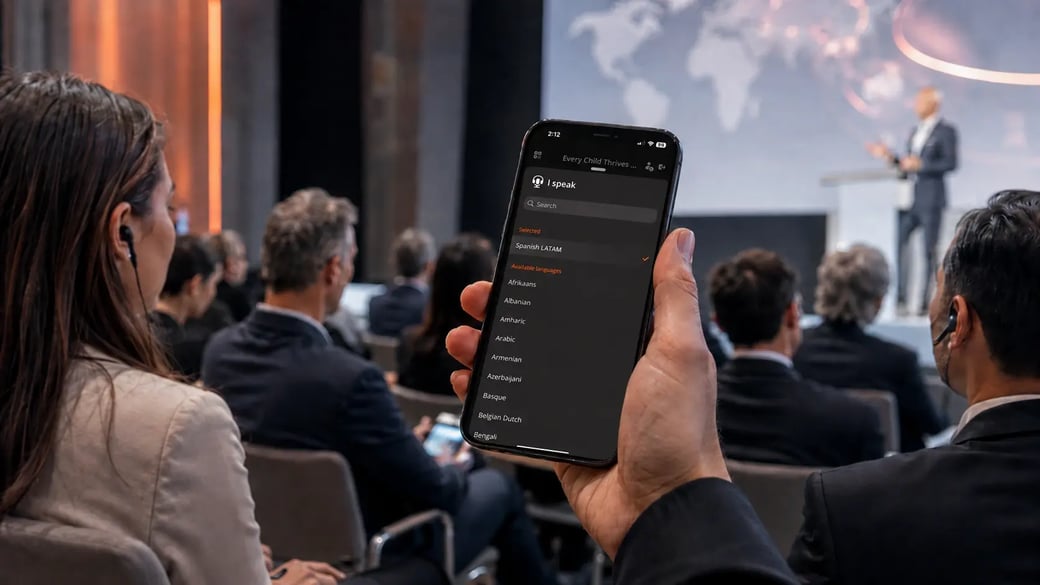
Picture a product launch with attendees joining from twelve countries, each expecting to follow along in their own language without a hitch. A few years ago, delivering that experience meant booking interpreters, installing booths, and hoping the technology held up on the day. Now it often means choosing the right app.
Live translation apps have moved from a nice-to-have to a baseline expectation for international events, whether in-person, hybrid, or fully virtual. But not all apps solve the same problem, and the differences matter once you are comparing real options for a real event. This post breaks down what to look for, the main categories of tools available, and how to match a solution to your event's actual demands.
Why the App Layer Matters
The app is where your audience experiences multilingual access, regardless of what is happening behind the scenes. A polished interpretation setup can still feel clunky if attendees struggle to find the right language channel or the audio lags behind the speaker. Equally, a slick app interface cannot compensate for inaccurate or delayed translation underneath it.
This is why evaluating a live translation app means looking at two layers together: the translation engine itself, and the interface attendees actually use to access it. Treating them as one decision, rather than two separate ones, leads to better outcomes.
Types of Live Translation Apps
The live translation app market splits along one key fault line: whether the app offers human interpretation, AI speech translation, or both. This distinction shapes everything from cost to accuracy to how the app should be evaluated for a given event.
AI-only platforms
AI-only platforms rely entirely on machine translation, with no option to bring in a human interpreter through the same tool. Wordly is a clear example of this model: the platform is built around instant AI translation, live captioning, transcripts, and summaries, and is explicitly positioned as removing the need for human interpreters or special equipment. This makes it fast to deploy and straightforward to budget for, but it means organisations cannot fall back on human interpretation within the same platform if a session calls for it.
Hybrid platforms
Hybrid platforms offer both AI speech translation and human interpretation, often within the same app and account. KUDO follows this model, specialising in continuous, real-time speech translation powered by both professional human interpreters and AI, and allowing organisations to mix and match between AI and human interpretation across different plans and meeting types. Interprefy takes this hybrid model further. Through the Interprefy mobile app, attendees can access AI speech translation, live captions, human interpretation, transcripts, and remote support from one platform. For event organisers, that means the language setup can be matched to the needs of each session, rather than forcing the whole event into one model. A high-stakes keynote can use professional interpreters, a breakout session can run with AI speech translation, and live captions can support accessibility throughout. With remote support available along the way, organisers also have a clearer fallback path if something changes before or during the event. 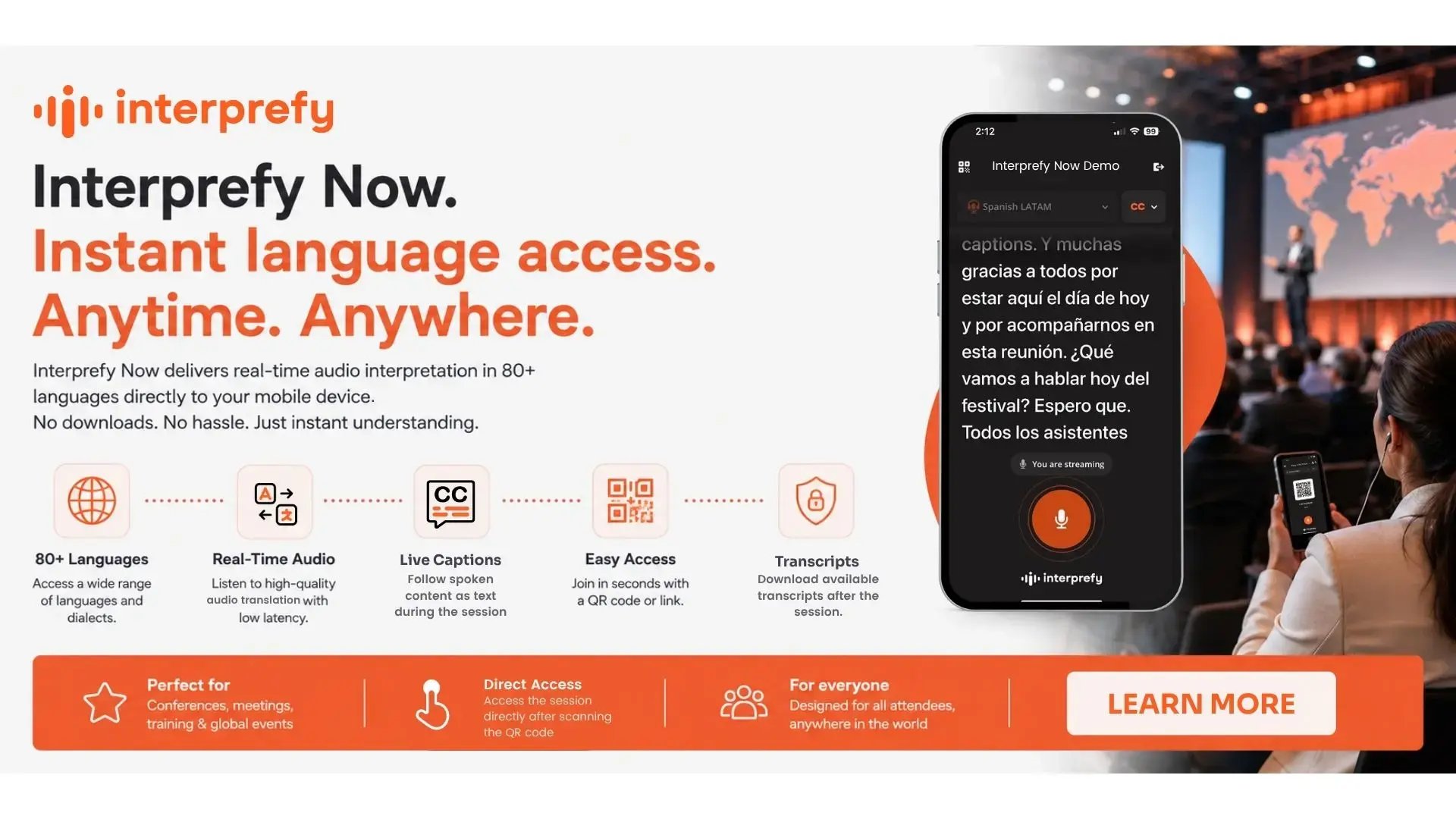
Captioning-focused tools
Captioning-focused tools prioritise text output over audio, either as a standalone feature or as part of a broader AI or hybrid offering. Most major platforms, including the ones above, now include live captions as a core feature rather than a separate product, since captions serve both accessibility needs and attendees who prefer reading along to listening.
The practical implication is that "AI versus human interpretation" is not really a choice between two different apps. For platforms like Interprefy, it is a choice within the same app, made on a session-by-session basis. For AI-only platforms like Wordly, that flexibility is not part of the offering, which is a meaningful factor to weigh if any part of your event calendar includes high-stakes sessions where human interpretation is the safer choice.
What to Look For When Comparing Apps
A few criteria consistently separate apps that perform well at scale from those that struggle once an event grows beyond a small pilot.
Language coverage should be checked against your actual audience. A high total language count is a good signal of breadth, but it is worth confirming that your specific language pairs, including less common combinations, are well supported and not just technically listed.
Platform integration determines how much friction attendees face. An app that works natively within Zoom, Microsoft Teams, or your existing event platform removes a login step that would otherwise cause drop-off, especially among less tech-savvy attendees.
Latency and reliability become critical the moment an event goes live. A translation delay of a few seconds is barely noticeable; one of thirty seconds breaks the experience entirely, particularly during interactive sessions.
Accuracy with specialised terminology matters for technical, medical, or industry-specific content, where a generic engine may stumble over jargon that a custom vocabulary feature would handle correctly.
Onsite flexibility is worth checking if you run in-person or hybrid events. Some apps require no additional AV equipment beyond attendees' own phones, which simplifies logistics considerably compared with traditional booth-based setups.
Matching the App to the Event
A single annual shareholder meeting with strict accuracy requirements points towards human interpretation, supported by an app that makes language selection effortless. A recurring series of regional sales kick-offs, where speed and cost efficiency matter more than perfect precision, often favours an AI speech translation app instead. Large public-facing conferences frequently benefit from combining both: interpretation for keynotes, AI translation or captions for the long tail of breakout content.
The right comparison, in other words, is not "which app is best" in the abstract, but which app fits the risk profile, audience size, and language complexity of the specific event in front of you.
Choosing A Live Translation App With Confidence
Live translation apps have matured to the point where multilingual access is no longer the hard part of running a global event; choosing the right tool for the job is. Start by mapping your event types against the categories above, test shortlisted apps with your own content rather than a generic demo, and weigh integration and reliability as heavily as language count.


 Download from the App Store
 Download from Google Play
 More download links