It’s hard to believe that just a few years ago most events were not fully capable of reaching large multinational audiences. Now, web conferencing and video broadcasting platforms, like ON24, Zoom and Microsoft Teams, have removed physical limitations from virtual events. Event planners and marketing teams are now able to attract audiences from across the globe, as long as they have a strong internet connection. However, inefficient language translation remains a stark barrier of access to events and creates extra friction. Without a common language or translation tool, many people feel excluded and will not attend the event.
4 min read
Web conferencing with live language translation: options and cost
%20(14)%20(1).png)
Topics: Remote Simultaneous Interpretation Live Captions Event Planning and Hybrid Events Microsoft Teams & Platform Integrations
3 min read
Why Add Live Captions to Your Next Event? | Interprefy
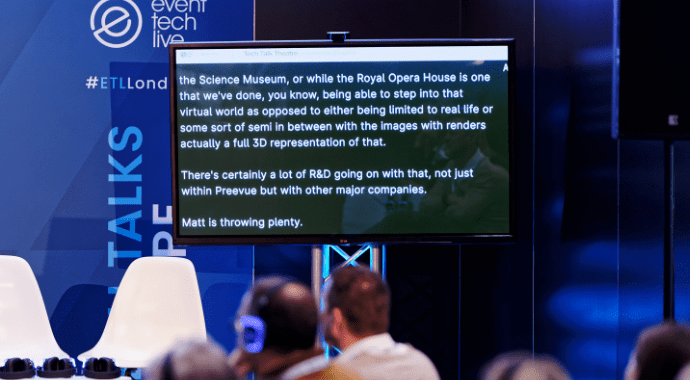
What is the connection between Netflix, Facebook, Instagram, Vimeo, and YouTube? Without a doubt, they are among the top video consumption platforms today. But they all have one thing in common: all of these video platforms include captions or subtitles for video uploads as part of their core features. Why? Let's dive into some of the key benefits of live captioning:
Topics: Live Captions Accessibility & Compliance Event Planning and Hybrid Events
7 min read
Closed Captions vs Subtitles - what is the difference?
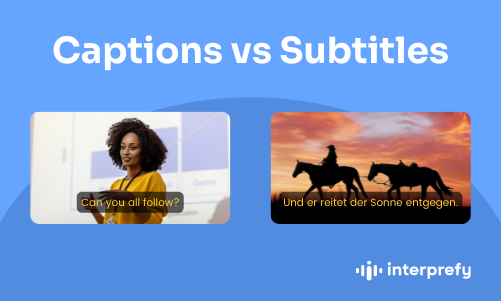
Whether you are a content creator, event manager, meeting organiser, or busy professional, adding subtitles or closed captions to your live content and videos is a game-changer.
A recent study by UK charity Stagetext reports that four out of five young people use subtitles when they watch TV. The charity's research further suggested an average of 31% of people would go to more live events if more had captions on a screen in the venue.
Subtitling and captioning have begun to shape a new norm of how people consume videos and live content. But as soon as words start appearing on video screens, many people tend to use the terms captions and subtitles interchangeably.
Let's look at subtitles and captions in-depth: What are they, and how do they differ?
In this article, we’re going to look at the differences between subtitles, and captioning, and what their best use case is.
In this article:
1. Captioning
1.3. Where captions can be used
1.4. How people access captions
1.6. How captions are generated
2. Subtitles
2.3. The benefits of subtitles
2.4. Where subtitles can be used
2.5 How subtitles are generated
Topics: Live Captions Interpreters & Professional Services
6 min read
Translation, interpretation, captions, subtitles - what's the difference?

In an era of globalization, business communication is reaching across international borders, geographic locations and time zones, and getting closer to barrier-free communication than ever.
As more events leverage digital technologies and hybrid formats, it’s increasingly easy for interested parties to participate in seminars, conferences, meetings, and the like — all in their chosen language. Ultimately ensuring multilingual communication doesn't get interrupted by language barriers.
And it’s all thanks to talents and technologies that allow for translation, interpretation (both simultaneous and consecutive), captioning, and subtitling to take place virtually and manifest locally.
Across the globe, these technologies are transforming how content is delivered and bridging communication gaps. They are enabling greater collaboration, supporting more opportunities to spread knowledge, helping people to pursue new business opportunities, and allowing us all to embrace other cultures.
It’s important to note that these processes all operate independently and are not interchangeable — so getting the most out of them means understanding how each one works and their best use-case scenarios.
In this article, we’re going to look at the differences between translation, interpretation, subtitles, and captioning, and where their best use case is.

 Download from the App Store
 Download from Google Play
 More download links