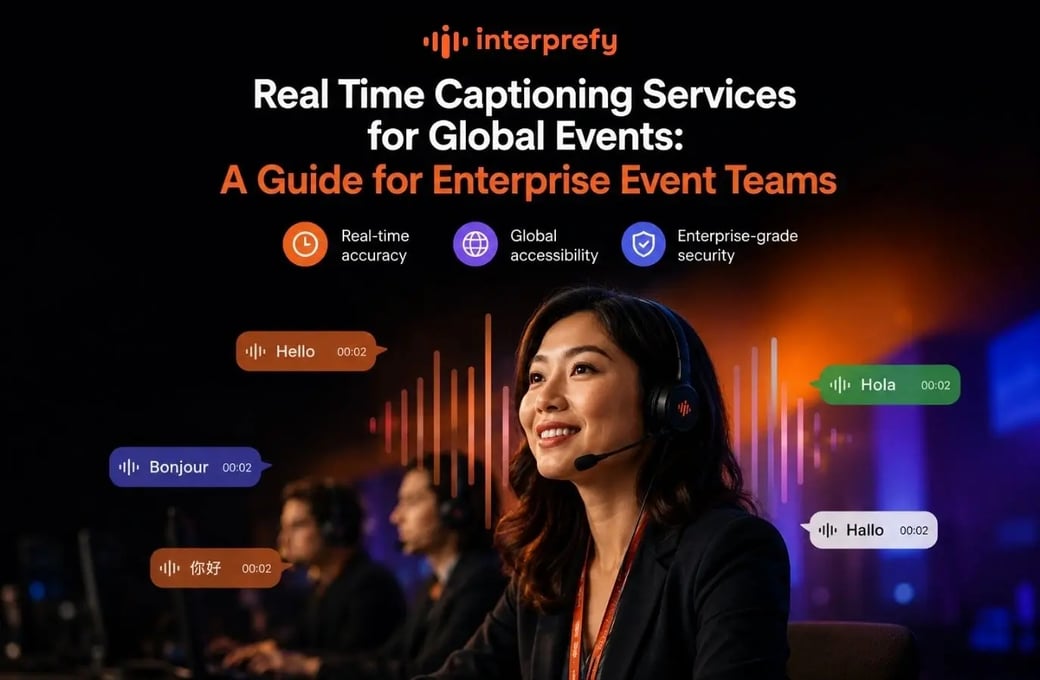
Imagine you’re at a multilingual event where interpretation was available and everything seemed inclusive, but you still missed a sentence and could not go back or follow everything was said. Sounds familiar? Perhaps the speaker moved too quickly, the audio dipped for a moment, or you were taking notes when an important point was made. At live events, even strong interpretation and good production do not always prevent information from being missed.
That is where real-time captioning adds another layer of access. Real time captions give attendees a live text version of what is being said, helping them follow the session when audio quality, pace, terminology or concentration become a barrier. For enterprise organisations running conferences, town halls, training sessions and webinars, this is not only about accessibility. It is about making sure more people can understand, retain and act on the content being delivered.
In this guide, we’ll walk you through what real-time captioning services actually are, how they work, the different captioning options available today, and what to look for when choosing a solution for your events. Whether you’re planning an international conference, a company-wide town hall, a training session or a busy trade show, this is what you need to know to make captions a practical part of your event experience, not something added only when accessibility is raised at the last minute.
What Are Real Time Captioning Services?
Real-time captioning services convert spoken content into text as people speak, displaying captions on screen during a live event, meeting or broadcast. Unlike traditional transcription, which is produced after a session has ended, real-time captions are delivered instantly, allowing attendees to read along while the conversation is still happening.
Captions can be displayed within event platforms, webinar software, mobile devices, venue screens or dedicated caption windows. They are increasingly used alongside interpretation and live translation services to create a more accessible and engaging event experience.
For enterprise organisations, real-time captioning supports a wide range of events, including conferences, product launches, internal communications, training programmes and hybrid meetings.
Why Are Real Time Captioning Services Important for Your Enterprise Events?
When investing in an event, you are not just paying for the venue, the platform, the speakers or the production team. You are investing in attention. You want people to understand the message, remember it and do something with it afterwards.
That is where captions can make a real difference. Research from Stagetext found that 74% of people believe captions improve their experience, while 42% use them to help maintain concentration and keep up with fast-paced content. These findings suggest that captions support a much broader audience than many event organisers assume, particularly in environments where attendees are processing complex information, taking notes or dealing with distractions.
At the same time, Interprefy's 2025 market research shows that live multilingual captions are becoming more familiar within the events industry. More than half of organisers and attendees surveyed (53%) have already experienced live multilingual captions. However, awareness is still developing, with 46% of event organisers in APAC and 45% in the Middle East reporting that they are not familiar with the technology.
For enterprise leaders, the value is straightforward. Captions help more people stay with the content while it is being delivered, which means your presentations, panels, training sessions and leadership updates have a better chance of being understood, remembered and acted on.
Real-time captions help organisations:
- Improve accessibility for deaf and hard-of-hearing participants
- Support attendees who are not native speakers
- Increase comprehension during technical presentations
- Improve engagement during virtual and hybrid events
- Meet accessibility and inclusion requirements
For many organisations, captions are no longer viewed as an optional feature. They are becoming a standard expectation for professional events.
How Do Real Time Captioning Services Work?
If you have never used a real‑time captioning service before, it helps to understand what is happening the moment someone begins speaking and the captions start appearing on a screen. Although the experience feels simple for the viewer, the process behind it involves a sequence of tightly connected steps that work together to deliver text that is both fast and reliable.
1. Audio capture
Everything begins with the spoken word. The system captures the speaker’s audio through the existing AV setup in the room, a microphone connected directly to the captioning platform, or a virtual meeting integration that streams the audio feed in real time. This captured audio becomes the single source of truth for the captioning engine.
2. Speech recognition
Once the audio enters the system, it is processed by a speech recognition engine that converts the spoken words into text in the original language. Modern engines analyse tone, rhythm, and pronunciation while filtering out background noise and adapting to the speaker’s voice as they continue. This step is where the system determines the raw text that will later appear as captions.
3. Text refinement
Before the text is shown to the audience, it passes through a layer of processing that improves readability. This includes adding punctuation, correcting obvious recognition errors, and applying language models that help the system understand context. In human‑supported workflows, a captioner may refine the text manually in real time, ensuring accuracy for technical or high‑stakes content.
4. Subtitle translation
When subtitles are required, the refined text is passed through a translation engine that converts it into the target language. This happens in real time and in parallel across every active language combination, allowing multilingual audiences to follow the content in the language that feels most natural to them. In workflows that involve human interpreters, this step is performed by a professional working live.
5. Output delivery
The processed text is then delivered to the audience in the format they have chosen. This may be live captions displayed on their screen, on venue displays, or inside a meeting platform. The system streams each line of text with minimal delay, allowing viewers to follow the speaker almost as quickly as if they were listening directly.
What differentiates advanced captioning platforms is their ability to combine technologies, match the right engine or human expertise to the content, and deliver everything through a single interface that attendees can access on their own devices without the need for dedicated hardware.
What Are the Different Types of Real-Time Captioning?
There are several ways to deliver real-time captions, and each one fits a different type of event.
AI-Powered Captioning
AI-powered captioning uses automatic speech recognition to generate captions as the speaker talks. It is often a strong fit for webinars, internal meetings, training sessions and large-scale events where you need a fast, scalable way to support access.
The main advantage is flexibility. You can make captions available across more sessions without needing the same level of manual resource for every meeting. This is especially useful if your organisation runs frequent events across teams, regions or departments.
Human Captioning
Human captioning uses trained captioners to produce live captions. It is often used when accuracy is especially important, such as legal, government, medical, technical or high-profile corporate settings.
You might choose human captioning for executive briefings, sensitive internal meetings or public-facing events where errors would carry more risk.
Multilingual Captioning or Subtitling
Multilingual captioning, also known as subtitling, allows attendees to read captions in different languages. This is especially valuable when your audience is international and you want to support people who may not be fully comfortable following the floor language.
For enterprise events, multilingual captions can sit alongside interpretation, AI speech translation or subtitles to create a fuller language access experience.
Hybrid Captioning
Hybrid captioning combines AI with human support. This can give you the speed and scalability of AI while adding an extra layer of quality control for sessions where accuracy matters.
For many enterprise teams, this is the practical middle ground. You can scale captions across more events while still applying human expertise where the content is more complex or sensitive.
What Is the Difference Between Real-Time Captioning and Transcription?
Real-time captioning and transcription are often confused, but they solve different problems.
Real-Time Captioning
Real-time captioning provides immediate text while an event is taking place. The audience can read the captions as speakers talk.
Transcription
Transcription creates a written record after the event has ended. It is useful for documentation, content repurposing, and compliance requirements.
For live events, real-time captioning is the preferred solution because it supports audience participation as content is being delivered.
Related article:
What Is Real Time Translation — And Why Does It Matter for Your Events and Meetings?
Where Are Real-Time Captioning Services Being Used Today?
Real-time captioning services are being used wherever event organisers need spoken content to be easier to access, follow and understand, including conferences, trade shows, hybrid events, webinars, public sector events and internal company meetings.
International conferences and summits — where captions help attendees keep up with complex presentations, technical terminology, and fast-moving panel discussions.
Trade shows and exhibitions — supporting visitors on busy show floors where background noise, accents, and packed agendas can make it harder to catch every word.
Accessibility-focused events — helping people who are deaf or hard of hearing take part more fully, while also supporting attendees who prefer to read along.
Charity and public sector events — making important information easier to access for diverse communities, multilingual audiences, and people joining in different environments.
Hybrid and virtual events — giving remote attendees a clearer way to follow sessions when audio quality, internet issues, or distractions get in the way.
Corporate meetings, webinars and internal communications — helping employees stay engaged during town halls, training sessions, product updates, and global team meetings.
What to Look For When You're Choosing a Real-Time Captioning Service Partner
If you're evaluating providers, here are the capabilities that matter most.
Accuracy you can trust. Captioning is only useful if attendees can rely on what they are reading. Look for a provider that consistently delivers high accuracy rates, even when speakers have different accents, use technical terminology, or speak at pace. The best solutions allow event teams to improve accuracy further with custom glossaries and event-specific terminology.
Support for multilingual audiences. Many events need more than captions in a single language. If your audience is international, look for a provider that can deliver translated captions across multiple languages in real time, helping attendees follow content in the language they understand best.
Flexible delivery options. Attendees should be able to access captions in the way that works for them. Whether captions are displayed on presentation screens, within event apps, on streaming platforms, or on personal devices, the experience should be simple and intuitive.
Seamless integration with your event technology. Captioning should fit into your existing workflow, not create additional complexity. Look for solutions that integrate easily with virtual event platforms, video conferencing tools, streaming services, and on-site AV setups.
Scalability for events of any size. The requirements for a 50-person webinar are very different from those of a global conference with thousands of attendees. Your captioning provider should be able to support multiple sessions, large audiences, and complex event formats without compromising performance.
Accessibility expertise. Real-time captioning is often a key part of an event's accessibility strategy. Choose a partner that understands accessibility requirements and can help you create a more inclusive experience for attendees who are deaf or hard of hearing, as well as those who simply prefer to read along.
Event support when it matters most. Live events leave little room for technical issues. Dedicated project management, pre-event testing, live monitoring, and on-demand technical support can make the difference between a smooth experience and a stressful one. The strongest providers combine reliable technology with experienced event support teams who stay involved from planning through delivery.


 Download from the App Store
 Download from Google Play
 More download links