Think about the last large event you attended or organised. How many of the people in that room — or joining virtually from around the world — were expected to simply follow along in a language that wasn't their own?
For a lot of organisations, that's still the default. English gets chosen as the floor language, and anyone who doesn't speak it fluently is left to piece together what they can. It feels practical. It's actually a barrier — one that quietly limits engagement, participation, and the value of the event itself.
Real time translation changes that. And in 2026, it's more accessible, more capable, and more essential than it's ever been.
In this write-up, we'll walk you through what real time translation actually means, how the technology behind it works, the different approaches available to you today, and how to know which one fits your needs. Whether you're running a global conference, a town hall with teams across five countries, or a trade show with international exhibitors, this is the information you need to make language access a real part of your event strategy — not an afterthought.
So, What Exactly Is Real Time Translation?
Real time translation is the process of converting spoken language from one language into another as it happens — live, during the conversation or presentation, with no pause for the speaker and no delay for the listener.
It's not the same as typing a sentence into a translation app. It's not someone taking notes and summarising afterwards. Real time translation means that when a speaker in Paris says something in French, a delegate in Seoul hears it in Korean within moments — with the flow of the conversation intact and the meaning preserved.
This is sometimes called live translation, simultaneous translation, or AI speech translation depending on who's delivering it and how. The core idea is the same: no one is left waiting, no one misses the moment, and language stops being the reason someone can't fully participate.
Why This Matters More Than You Might Think
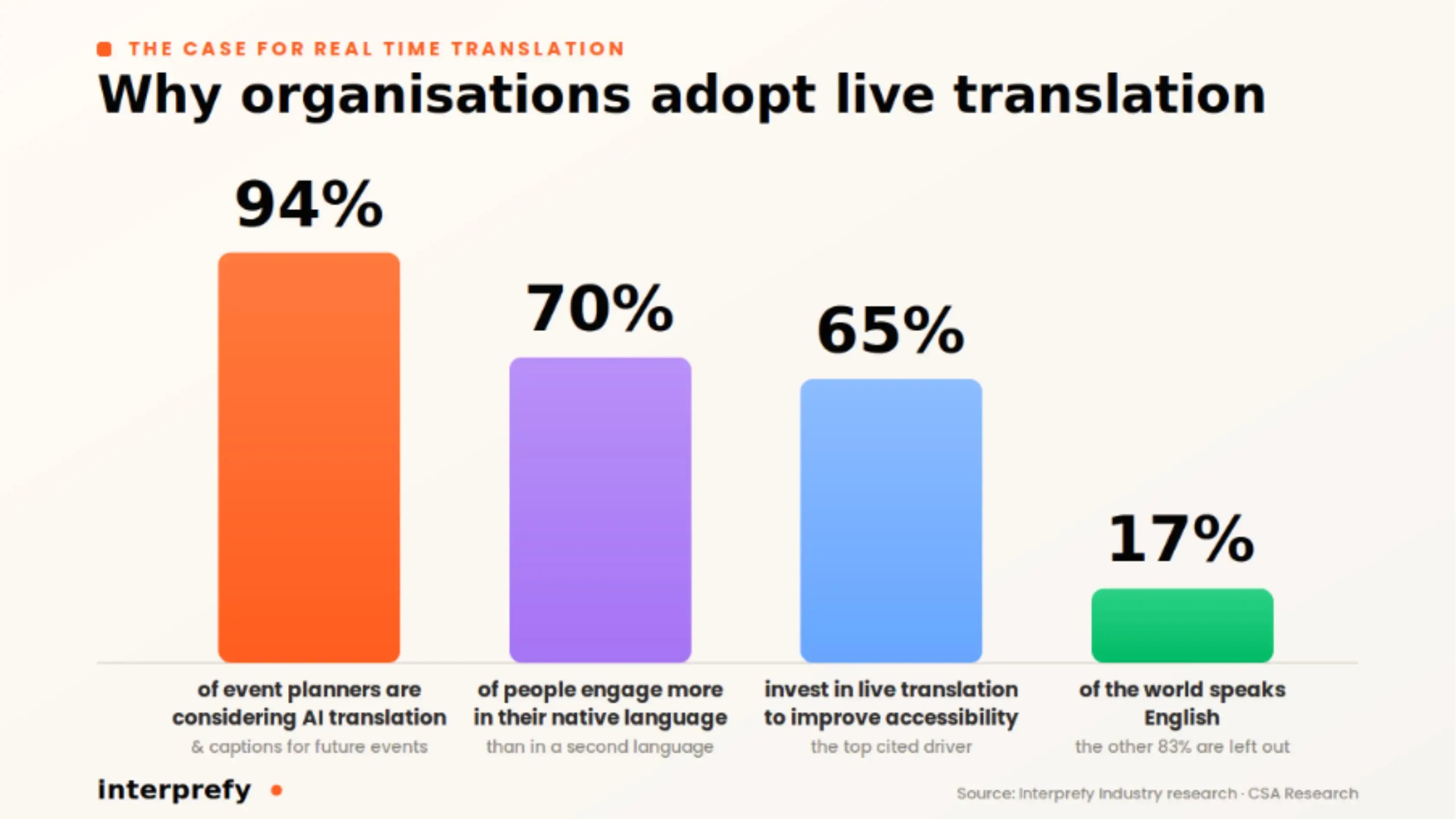
Here's a number worth sitting with: around 17% of the world speaks English. That means if you're running your events, meetings, or communications in English only, you're already asking the other 83% to work harder just to keep up.
And the research backs up what that costs you. More than 70% of people engage more deeply when content is delivered in their native language. That's not just a preference — it shows up in how much people retain, how actively they participate, and whether they feel the event was worth their time.
94% of multilingual event planning professionals are already considering adding AI speech translation and captions to their future events. A further 65% of organisations that use live translation services say the main reason they invested was to improve audience accessibility. And 61% point to engagement as the driving factor.
These aren't small improvements. Language access, done well, changes the entire experience for a significant portion of your audience.
The Different Types of Real Time Translation / Interpretation
Not all real-time translation solutions work the same way, and the right approach depends on your event type, your audience, your budget, and the level of complexity involved. These factors will help determine whether AI-powered real-time translation is sufficient or whether human interpretation is the better choice. Here's how the main options break down.
Consecutive Interpretation
Consecutive interpretation is where an interpreter listens to the speaker, waits for them to finish a passage, and then delivers the translation/interpretation— one language direction at a time. It's the oldest and most widely used form of interpretation globally, and it still accounts for the largest share of revenue in the language services industry worldwide.
For good reason. In settings where precision is paramount — a legal deposition, a medical consultation, a patient consent conversation, a regulatory hearing — consecutive interpretation offers something that simultaneous cannot always replicate: the space to process, verify, and render meaning with complete care. The interpreter hears the full thought before translating it. That matters when a misunderstood word has real-live consequences.
It's also the model most familiar to healthcare providers, legal professionals, and government bodies who have built their language access workflows around it for decades.
As the multilingual communication landscape evolves, the need to support consecutive workflows alongside remote simultaneous and live translation is becoming increasingly clear. The organisations that will lead in this space are the ones building solutions that serve the full spectrum of how interpretation is actually used — not just the conference room and the webinar, but the consultation room and the courtroom too.
Traditional Simultaneous Interpretation
Simultaneous interpretation is what you'd recognise from an institution like the United Nations — interpreters working in real time, rendering the speaker's words into another language as they speak, with listeners hearing the translation through a receiver and earpiece. It's highly effective and produces the best quality for complex or high-stakes content.
The challenge is the setup. Traditional simultaneous interpretation requires physical interpreter booths, dedicated AV infrastructure, headsets for every attendee, and a team of qualified specialists. It's expensive, logistically demanding, and until relatively recently, largely out of reach for anything outside major institutional events.
Remote Simultaneous Interpretation (RSI)
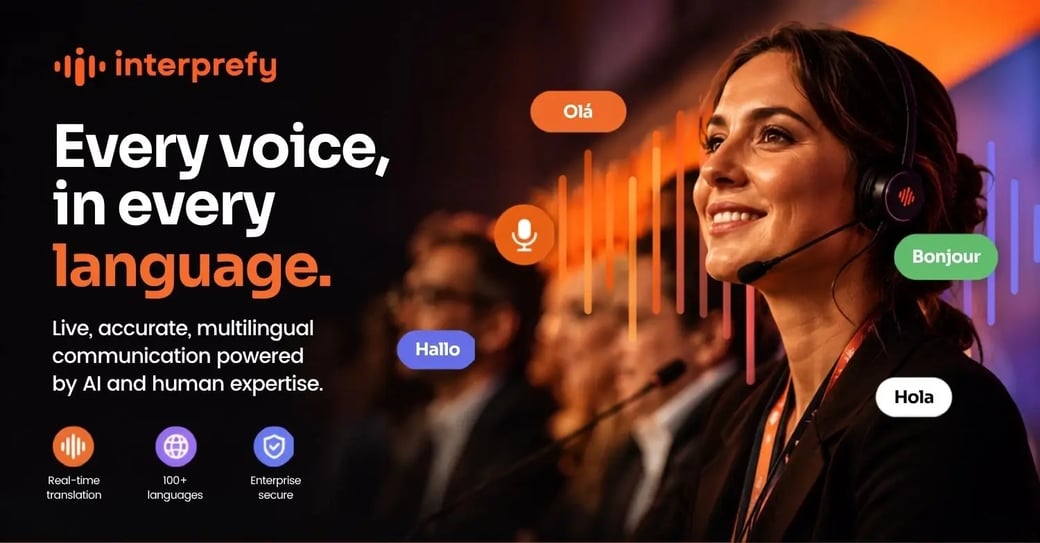
Remote simultaneous interpretation works almost the same way — professional interpreters, real time delivery, no interruption to the speaker's flow — but the interpreters work from anywhere in the world instead of a physical booth on-site. They receive the audio feed via a cloud platform, interpret in real time, and attendees listen via a dedicated platform such as the Interprefy app on their own devices.
This is one of the biggest shifts the industry has seen. RSI makes professional simultaneous interpretation far more accessible: it removes the hardware requirement, opens up access to a genuinely global pool of interpreters (which matters enormously for rare language combinations), and makes the experience available on something attendees already have in their pocket.
At Interprefy, RSI has been the foundation of what we do since 2014. We started with this problem — how do you deliver high-quality interpretation at scale, flexibly, without the traditional barriers — and it's shaped everything we've built since.
AI Speech Translation
AI speech translation or AI-powered real time translation does what RSI does, but automatically — no human interpreter in the loop. The spoken audio is captured, processed through a dedicated speech recognition engine, translated, and delivered back to listeners as translated audio or live captions, all within a fraction of a second.
The accuracy of AI translation has improved dramatically over the past few years, following the emergence of large language models capable of understanding context and nuance more effectively. For many use cases — large audience events, internal meetings, webinars, breakout sessions, content with a clear and structured delivery — AI speech translation provides a fast, cost-effective, and scalable solution that makes multilingual access genuinely practical for organisations that couldn't otherwise afford or logistically manage full interpretation.
Interprefy AI benchmarks the leading speech recognition and translation engines available and selects the best-performing combination for each specific language pair rather than applying a single model across everything. That distinction matters for quality. We also support Custom Vocabulary — meaning you can pre-load your event-specific terminology, product names, brand names, and acronyms so the AI handles them accurately from the start. No generic model guessing at your industry's language.
A Hybrid Approach
The most sophisticated events use both. Professional human interpreters where the content is complex, high-stakes, or legally or diplomatically sensitive — AI handling wider accessibility, large audience delivery, and sessions where cost-efficiency and scale are the priority. Interprefy's platform integrates both under one roof, which means you're not choosing between quality and accessibility. You're getting both, matched to the right session.
Related article:
6 reasons (with data) why your business needs live translation
How Real Time Translation Actually Works: Behind the Scenes
If you've never used a real time translation platform before, it's worth understanding what's happening when a delegate picks up their phone, selects their language, and starts listening.
1. Audio capture. The speaker's audio is captured — either through the event's existing AV setup, a microphone directly into the Interprefy platform, or through Interprefy Agent.
2. Speech recognition. The captured audio is processed by a speech recognition engine that converts the spoken words into text in the source language.
3. Translation. The transcribed text is passed through a translation model that converts it into the target language. For AI translation, this happens in real time, in parallel across every active language combination.
4. Output delivery. The translated content is delivered to each listener in their preferred format — as translated audio through their earpiece or headphones, or as live captions on their screen or on venue displays.
For RSI, step three is handled by a human interpreter working in real time. The rest of the infrastructure — capture, routing, delivery — is the same.
What makes Interprefy different in this process is the ability to combine engines, match the best technology to each language pair, and deliver all of this through a single platform that attendees access on their own devices, without dedicated hardware.
Related article:
Real Time Captioning Services for Global Events: A Guide for Enterprise Event Teams
Where Is Real Time Translation Being Used Today?
The short answer is: far more places than most people realise.
International conferences and summits — from the ITU's AI for Good Global Summit to the Europe-Asia Economic Summit in Davos, where over 200 delegates received live AI translation across six languages simultaneously.
Corporate all-hands and town halls — because internal communications in English only is an inclusion problem, not a practical solution.
Webinars and virtual events — attendees who follow in their native language stay longer, participate more, and get more out of the experience.
In-person meetings without AV infrastructure — negotiations, guided tours, pitches, training sessions. With Interprefy Now, all attendees need is their phone.
Trade shows and exhibitions — real time translation on the show floor turns international visitor traffic into actual conversations.
Sports and entertainment — at the 2025 UTS Nîmes tennis tournament, Interprefy delivered live subtitles on stadium screens for over 12,000 spectators in their own language.
What to Look For When You're Choosing a Real Time Translation Solution
If you're evaluating options, here's what should be on your checklist.
Language coverage that matches your audience. The headline number of supported languages is less important than whether the specific combinations you need are well-supported and well-tested. With Interprefy AI, over 80 languages and more than 6,000 language combinations are available — and each is benchmarked against the best available engines, not just listed as theoretically possible.
Custom vocabulary. Your event has terminology a general-purpose AI won't know. Product names, brand references, regulatory frameworks, industry acronyms — without a custom vocabulary feature, you're asking the model to guess. With it, you're giving the AI the context it needs to translate accurately from the first session.
Seamless integration. Real time translation that requires your attendees to switch platforms or install something they've never heard of will see lower adoption. Look for solutions that integrate directly into the platforms you're already using — Microsoft Teams, Zoom, Webex, Google Meet — or that join as an agent participant so nothing changes about how your meeting runs.
Live captions alongside audio. Some attendees will prefer to read rather than listen. Some will be in environments where audio isn't practical. Live captions in multiple languages aren't a secondary feature — they're how a meaningful portion of your audience will actually engage.
Enterprise-grade security. If your meetings include confidential or sensitive content, this is non-negotiable. Interprefy is ISO 27001 certified, with end-to-end encryption, controlled channel access, and confidentiality protocols for human interpreters. That's the baseline.
Support you can actually rely on. A technical issue in the middle of a live event is not the moment to raise a support ticket and wait. Dedicated project management, real time monitoring, and live technical support during critical sessions matter. This is an area where Interprefy's service model is a meaningful differentiator — we don't just provide the technology and leave you to run it.


 Download from the App Store
 Download from Google Play
 More download links