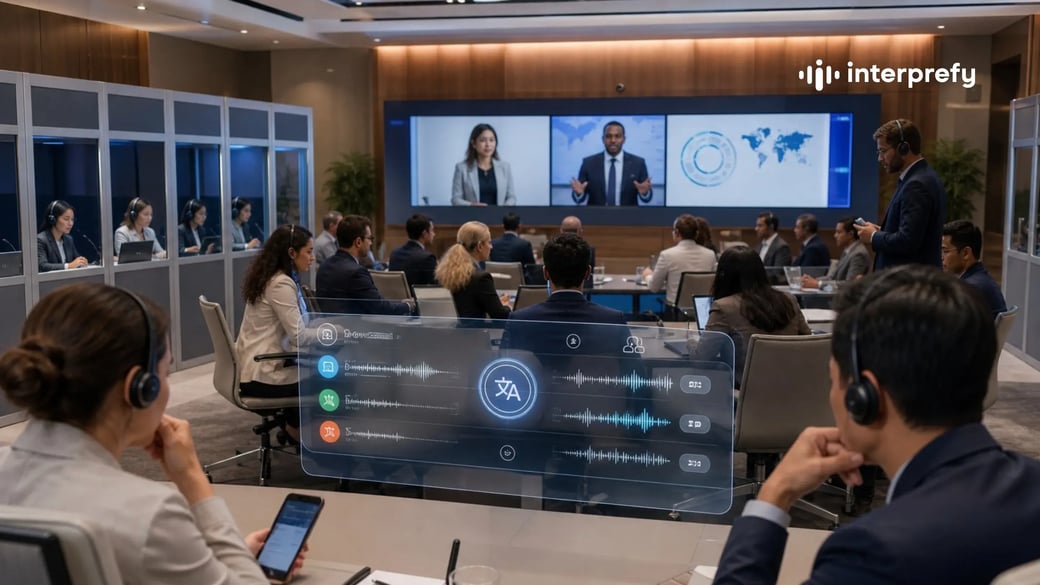
Multilingual events have long carried a predictable budget line: interpreters. For a full-day conference in three languages, traditional setups require six professionals rotating through physical booths, plus travel, equipment, and coordination costs that can reach $13,000 or more. For many meetings, those costs put interpreting services out of reach altogether. Now, AI speech translation is changing the calculation. Enterprise teams can extend multilingual access to more sessions, more languages, and more attendees without the per-event spend that once made interpretation a rationed resource.
This guide walks through the practical steps for reducing interpreter costs using AI translation technology. You will learn where AI works, where human interpreters still matter, and how to build a hybrid approach that protects quality while cutting spend.
Key Takeaways: How to Cut Interpreter Costs With AI Translation Technology
- AI speech translation can reduce interpreting expenses by around 70–85% (depending on the case) compared to traditional on-site setups with physical booths and interpreter travel.
- The hybrid model assigns human interpreters to high-stakes sessions while AI handles additional languages and lower-priority content at scale.
- Custom vocabulary and live monitoring are critical for accurate AI translation in technical, legal, or regulated industries.
- Interprefy combines enterprise-grade AI speech translation with access to over 6,000 professional interpreters, giving teams flexibility across event types.
- Cloud-based platforms eliminate AV equipment rentals, booth logistics, and interpreter travel, creating predictable annual budgets instead of variable per-event costs.
What Drives Traditional Interpreter Costs?
Before exploring cost reduction strategies, it helps to understand where the money goes in traditional interpretation setups. Several factors stack up quickly.
The Two-Interpreter Rule
Professional simultaneous interpretation requires two interpreters per language. They rotate every 20 to 30 minutes to prevent fatigue errors, a standard known as the AIIC rule of two. For a three-language event, that means six interpreters before you count travel or equipment.
Travel, Accommodation, and Per Diem
Finding qualified interpreters with subject-matter expertise often means flying them in from other cities or countries. Add flights, hotels, ground transport, and daily allowances, and non-interpreting costs can exceed the interpretation fees themselves.
Physical Booths and AV Equipment
On-site simultaneous interpretation traditionally requires soundproof booths, receivers for attendees, and dedicated audio infrastructure. Rental and setup fees add thousands to the budget, and venue constraints can limit your language options.
Minimum Booking Requirements
Many interpretation agencies set half-day or full-day minimums. A 90-minute session still incurs a half-day charge, making it expensive to add interpretation to shorter meetings or breakout sessions.
How AI Speech Translation Reduces Costs
AI speech translation addresses each of these cost drivers directly. Here is how the economics shift.
No Travel, No Booths, No Hardware
Cloud-based AI translation platforms run on existing infrastructure. Attendees access translated audio or captions on their own devices, reducing or eliminating the need for dedicated receivers, interpreter booths, and some on-site equipment. Industry reports on remote interpretation have cited average savings of around 70–85% compared with traditional on-site interpretation, although actual savings vary substantially by event size, languages, venue, and technical requirements.
Pay for Minutes, Not Minimums
AI speech translation typically charges by usage, not by half-day blocks. You can add multilingual support to a 30-minute webinar or a two-hour breakout session without paying for unused hours.
Scale Languages Without Scaling Staff
Adding a seventh or eighth language to a human-interpreted event means hiring two more interpreters plus associated costs. With AI, adding languages is a configuration change, not a staffing decision.
Predictable Annual Budgets
Organisations running multiple events per year can shift from unpredictable per-event interpretation spend to platform-based pricing. This makes multilingual communication a budgetable line item rather than a variable expense.
Where AI Translation Technology Performs Well
AI speech translation excels in specific contexts. Understanding these helps you allocate resources effectively.
Internal Meetings and Town Halls
Company-wide updates, leadership communications, and team meetings are ideal for AI translation. The content is typically straightforward, speakers are familiar, and the cost savings multiply across recurring sessions.
Training and Educational Content
Product training, compliance modules, and onboarding sessions often follow structured formats. AI handles these well, especially when you use live captions alongside audio translation for reinforcement.
Webinars and Virtual Events
Online events already require attendees to use devices. Adding AI-powered translation or captions fits naturally into the experience without additional hardware.
Breakout Sessions and Parallel Tracks
Traditional interpretation budgets often limit multilingual access to plenary sessions. AI makes it economically viable to extend translation to breakout rooms, workshops, and parallel tracks where attendees previously had no language support.
High-Volume Language Pairs
AI models perform most accurately on high-resource language pairs like English-Spanish, English-Mandarin, and English-French. Word error rates stay under 10%, and translation quality approaches professional standards for general business content.
Related article:
Mandarin Interpreting Services: A Practical Guide for Event Teams
Mandarin Interpreting Services a Practical Guide for Event Teams
Where Human Interpreters Still Matter
AI is not a replacement for human interpreters in every context. Certain situations demand the nuance, cultural awareness, and real-time judgment that only trained professionals deliver.
High-Stakes Negotiations
Board meetings, investor briefings, M&A discussions, and contract negotiations carry significant risk if a single phrase is misinterpreted. Human interpreters catch ambiguity, tone, and intent that AI can miss.
Legal and Regulatory Proceedings
Depositions, court hearings, and compliance presentations often require certified interpreters. Many jurisdictions do not accept AI translation for official records.
Medical and Clinical Contexts
Informed consent discussions, diagnosis explanations, and patient consultations involve liability and patient safety. Updated US healthcare regulations require that critical machine-translated communications with limited-English patients be reviewed by qualified humans.
Cultural and Creative Content
Speeches with humour, metaphor, or cultural references require interpreters who understand context beyond literal meaning. Marketing presentations, executive keynotes, and diplomatic communications often fall into this category.
Low-Resource Languages
AI accuracy drops significantly for languages outside the top 100 in training data. If your event includes Swahili, Tamil, or regional dialects, human interpreters remain the reliable choice.
How to Build a Hybrid Model for Maximum Savings
The most cost-effective approach combines AI and human interpretation strategically. Here is how to structure a hybrid model.
Map Your Sessions by Risk Level
Review your event agenda and classify each session. High-stakes content goes to human interpreters. Routine updates, training, and breakout sessions use AI. Sessions with technical content but lower risk might use AI with human monitoring.
Assign Languages by Volume and Importance
Your primary languages might warrant human interpretation throughout. Secondary languages with smaller attendee populations can run on AI alone, extending access without proportional cost increases.
Use AI as a Backup for Human Channels
AI can hold continuity if a feed drops or an interpreter needs a break. This redundancy improves reliability while allowing interpreters to maintain quality on their primary assignments.
Plan for Live Monitoring
In many cases, effective AI translation requires attention during the event. A remote support team can flag and solve issues in real time. This is not always optional for enterprise deployments.
How to Implement Live AI Translation for Your Events
Moving from traditional interpretation to AI requires preparation. Follow these steps for a smooth transition.
Step 1: Audit Your Current Interpretation Spend
Calculate your annual interpretation costs across all events. Include interpreter fees, travel, equipment, and internal coordination time. This baseline helps you measure savings accurately.
Step 2: Identify Pilot Opportunities
Choose events where AI translation carries low risk. Internal town halls, recurring team meetings, or training webinars make good starting points. Avoid piloting on board meetings or external-facing events with reputational stakes.
Step 3: Select an Enterprise-Grade Platform
Consumer-grade translation apps lack the reliability, security, and integration capabilities enterprise events require. Look for platforms with ISO 27001 certification, end-to-end encryption, and integration with your existing meeting tools.
Interprefy offers integration with 80+ platforms including Microsoft Teams, Zoom, Google Meet, and Webex. This means you can add multilingual support without changing how your team already runs meetings.
Related article:
What Security Standards Should Automatic Speech Translation Meet?
What Security Standards Should Automatic Speech Translation Meet
Step 4: Build Your Custom Vocabulary
AI translation accuracy improves dramatically with terminology tuning. Before your event, upload lists of product names, speaker titles, company-specific acronyms, and technical terms. This step alone can move accuracy from acceptable to excellent.
Step 5: Scale Based on Results
Validate AI performance before expanding coverage methodically. Then, add more languages, and extend to additional event types. Remember to keep human interpretation where necessary.
What Technical Requirements Should You Plan For?
Successful AI translation depends on several technical factors. Address these during planning to avoid problems during events.

Audio Quality

Latency

Devices & Wi‑Fi

Compliance
Audio Quality Matters More Than Model Quality
AI translation can only be as good as the audio it receives. Professional microphones, quiet environments, and clear speaker diction directly impact accuracy. Budget for audio upgrades if your current setup produces inconsistent results.
Latency Expectations
Modern AI translation can deliver translated captions in under one second and fully synthesised voice output in around 1.5–2 seconds in well-optimised setups. This is within (or below) the 2–4 second ear–voice span typical of human simultaneous interpreters, so attendees can follow along naturally in most meeting and event scenarios.
Device and Connectivity Planning
Attendees access translation on their own devices. Ensure your venue has adequate Wi-Fi capacity and consider providing QR codes for quick access. For in-person events, Interprefy Mobile Access lets attendees scan a code and receive translation on their smartphones with no app download required.
Compliance and Data Residency
For regulated industries, confirm where your translation data is processed and stored. European data residency, GDPR compliance, and assurance that your content will not be used to train AI models are baseline requirements for enterprise deployments.
How Much Can You Actually Save?
Cost savings vary by event type, language count, and current spend. Here are representative scenarios based on industry data.
Single-Day Event With Three Languages
According to Fora Soft's 2026 AI simultaneous interpretation playbook, a traditional setup with human interpreters costs $5,400–$13,200 per day including travel and equipment, while an enterprise AI platform alternative runs $800–$2,500. Typical savings: about 60–85%, depending on travel, language mix, and equipment needs.
Recurring Monthly Meetings
For organisations hosting monthly one-hour, two-language team meetings, human interpretation — based on two interpreters at an indicative half-day rate of $400–$800 per interpreter — would cost roughly $800–$1,600 per meeting, or about $9,600–$19,200 per year. An AI platform, using typical pricing of around $150–$300 per hour, would cost approximately $150–$300 per meeting, or about $1,800–$3,600 per year. On these assumptions, organisations could potentially save around 60–90%, depending on meeting length, provider rates, and pricing structure, while making interpretation available more consistently across meetings.
Multi-Day Conference With Six Languages
Traditional interpretation budget for a three-day, six-language conference typically runs $35,000 to $75,000. Hybrid approach with AI for breakouts and humans for plenaries brings this down to an estimated $12,000–$25,000, modeled from the same source's pure-AI figure for this scenario ($4,000–$12,000) blended with a smaller share of human coverage for plenary sessions. Interprefy and other providers already offer hybrid tiers built for exactly this kind of mixed deployment. This model also extends language access to breakout sessions that would otherwise have had no interpretation at all.
How Interprefy Helps Organisations Reduce Interpreter Costs
Interprefy combines enterprise AI technology with the flexibility to add human interpreters where they matter most. Here is what differentiates the platform.
Best-in-Class AI With Human Backup
Interprefy benchmarks multiple AI and large language model engines to select the strongest performer for each language pair. When a session requires human nuance, you can access over 6,000 professional interpreters through the same platform.
Custom Vocabulary for Accurate Terminology
The custom vocabulary feature trains the AI to recognise your event-specific terms, speaker names, and brand language. This ensures your message translates accurately across all languages.
Flexible Plans for Predictable Budgeting
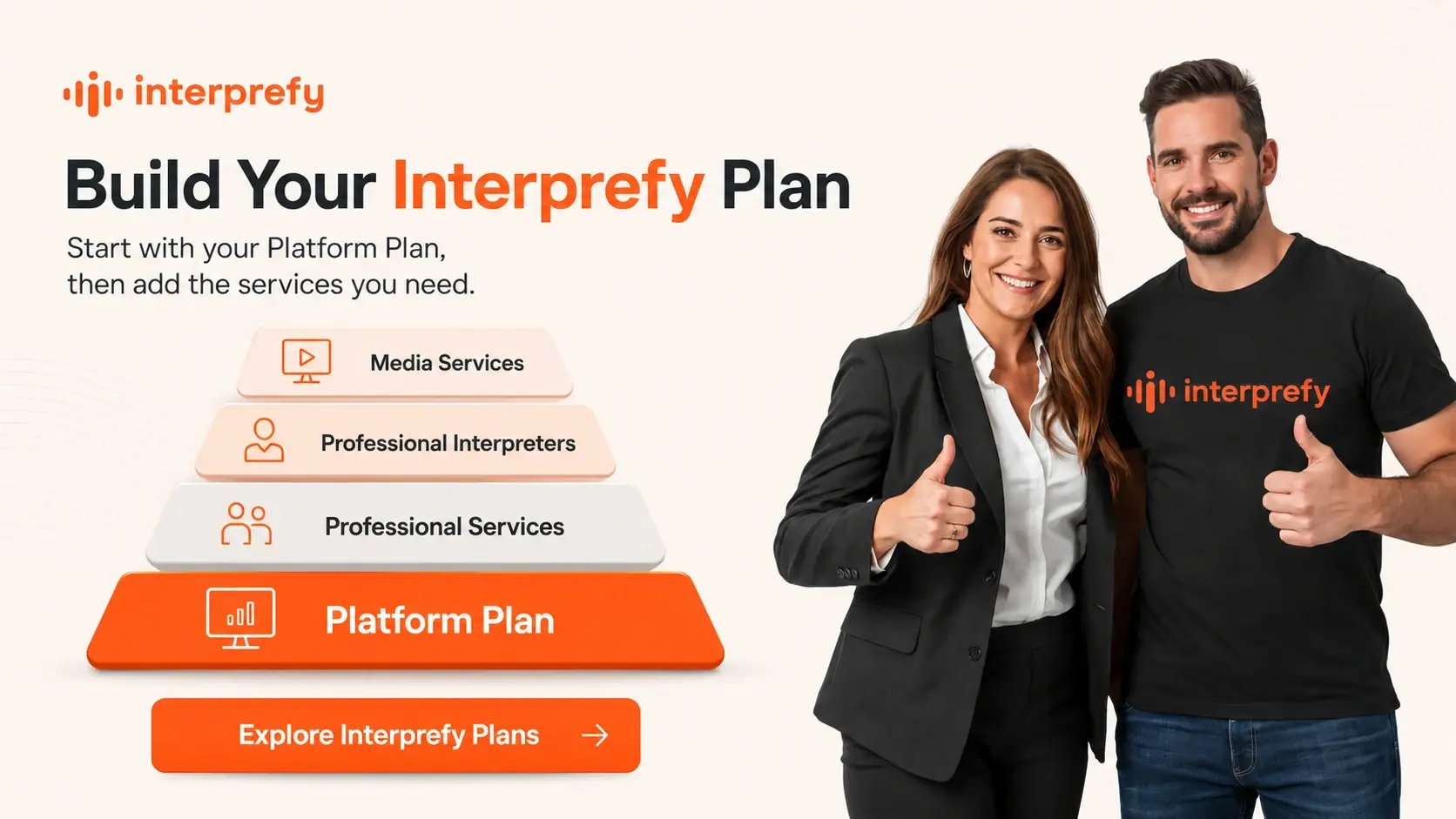
Interprefy Plans offer tiered options based on your organisation's needs. Platform Plans suit teams that manage events independently. Professional Services Plans add project management and technical support. Interpreter Plans give access to certified professionals.
Enterprise Security and Compliance
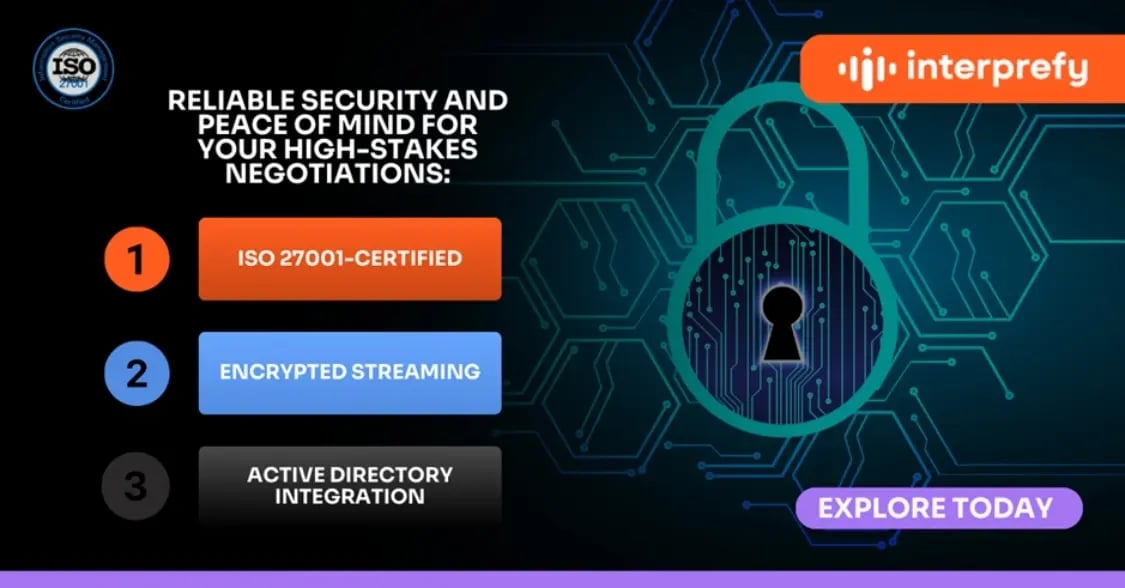
Interprefy is ISO 27001 certified, hosted in Europe, and GDPR compliant. Your event data is never used to train AI models, and end-to-end encryption protects every session.
Common Mistakes to Avoid When Cutting Interpreter Costs
Cost reduction efforts sometimes backfire. Learn from these common pitfalls.
Deploying AI Without Vocabulary Preparation
Skipping custom vocabulary setup is the single biggest accuracy killer. Industry terms, acronyms, and proper names will be mishandled unless you train the system in advance.
Using Consumer Tools for Enterprise Events
Free translation apps lack the reliability, security, and integration capabilities that enterprise events demand. A mid-session failure or data breach costs far more than the platform savings.
Eliminating Human Interpreters Entirely
For high-stakes sessions, human interpreters are insurance against costly misunderstandings. The goal is strategic allocation, not complete replacement.
Ignoring Compliance Requirements
Legal, healthcare, and financial industries have specific interpretation requirements. Verify that AI meets your regulatory obligations before deploying.
Forgetting Post-Event Content
AI translation creates opportunities for multilingual recordings, transcripts, and summaries. Plan for these deliverables so you capture full value from your investment.
Measuring the ROI of AI Translation
Track these metrics to demonstrate value to stakeholders.
Direct Cost Savings
Compare your AI platform spend against what traditional interpretation would have cost for the same events. Include interpreter fees, travel, equipment, and coordination hours.
Expanded Access
Count the sessions, languages, and attendees who received multilingual support that would not have been economically viable before. This expansion represents value beyond direct savings.
Quality Scores
Survey attendees on their ability to follow content in their language. Collect feedback comparing AI and human-interpreted sessions to calibrate future decisions.
Operational Efficiency
Measure the reduction in event planning time, vendor coordination, and logistical complexity. Platform-based approaches typically reduce these burdens significantly.
In Conclusion: A Practical Path to Lower Interpreter Costs
Affordable interpretation doesn't mean less multilingual access, it means access for the people and events priced out of it before. AI speech translation makes it possible to extend language support to more sessions, more languages, and more attendees than traditional interpretation budgets allowed. The key is strategic implementation: use AI where it performs well, reserve human interpreters for high-stakes content, and build custom vocabulary that ensures accuracy.
Start with a pilot, measure results, and scale based on evidence. Organisations that take this approach typically achieve 60% to 75% cost reductions while improving overall multilingual coverage. The technology is ready. The question is whether your budget is still structured around the constraints of traditional interpretation.



 Download from the App Store
 Download from Google Play
 More download links