
If you are choosing a language interpretation provider, the challenge is rarely limited to one event. You may be sourcing support for a leadership meeting today, a webinar next month, and a global event after that, each with different requirements, stakeholders, and risks.
If this is your first time evaluating interpretation services, the process can feel crowded and hard to compare. If you have done it before, the frustration is different: you already know how much time it takes to recheck capabilities, assess support levels, and confirm whether each provider can meet your standards again.
That is exactly why choosing a partner matters more than choosing a supplier. You need a language interpretation partner that can support your organisation reliably across formats, teams, and ongoing needs. So, how do you choose a language partner that can meet your needs now and still support you as those needs grow?
Here are seven questions to ask before you decide.
1. Can This Provider Support Both One-Off Events And Ongoing Multilingual Programmes?
This is one of the first questions you should ask, because multilingual communication often expands faster than expected. A single board meeting can turn into a quarterly webinar series. A one-off conference can become a recurring global programme.
That growth is not hypothetical. Interprefy’s 2025 market research found that 86% of Middle Eastern business event organisers and 71% of APAC organisers reported high or very high demand for multilingual live translation and interpretation services. The same research found that 98% of organisers in the Middle East and 81% in APAC would be likely or very likely to use remote simultaneous interpretation, AI-powered speech translation, or live captions.
Interprefy addresses this in a practical way. If you need support for a shorter session, hourly pricing can make sense. If you are running a fuller event, daily pricing is designed for longer coverage and added support. If your organisation hosts multilingual meetings and events on a regular basis, Interprefy Plans give you a more structured way to support recurring needs across multiple sessions. That matters because a suitable partner should not force you to restart procurement every time another multilingual requirement appears.
Start Experiencing the Interprefy Difference
Explore Interprefy's Pricing Options Today!
2. Can This Partner Handle High-Stakes Communication Without Creating Extra Pressure For My Team?
You are not just buying access to interpreters or technology. You are buying confidence that the experience will be handled properly when the session is live.
That distinction matters in enterprise and institutional settings, where the pressure is real and the consequences of poor delivery can be highly visible. A multilingual board meeting, investor update, leadership town hall, public-sector briefing, or global event does not leave much room for uncertainty. If audio fails, handovers are unclear, captions are inaccurate, or participants cannot follow the discussion in their language, the impact is immediate. It affects comprehension, participation, credibility, and trust.
That is why the right interpretation partner should do far more than provide a platform or interpreter access. You need a partner that brings structure before the event, calm control during delivery, and accountable support throughout. In practice, that means clear preparation, technical checks, coordination across stakeholders, and live operational oversight once the session begins.
This is where Interprefy takes a different approach. Rather than treating interpretation as a standalone service, it offers a complete multilingual communication experience designed to feel straightforward, dependable, and human. That includes live language support, professional interpreters, AI speech translation, live captions, post-event transcripts, and the guidance needed to make everything work together in a practical way. The result is not more complexity for your team. It is more control.
This matters because as an organisation, you are not looking for more tools to manage. You need reassurance. If your team is already coordinating speakers, stakeholders, production schedules, compliance requirements, and audience expectations, that level of support is not an added extra. It is part of reducing operational risk and helping your event or meeting run with confidence. That is often the difference between a supplier that provides a service and a partner that helps you stay in control when it matters most.
What choosing the right partner looked like for Professional Photographers of America
3. Should You Choose Human Interpreters, AI Speech Translation, Or Both?
This is now a standard buying question, and rightly so. AI is moving quickly into mainstream enterprise use. McKinsey reported in March 2025 that 78% of organisations use AI in at least one business function, while 71% regularly use generative AI in at least one business function.
However, that does not mean every multilingual setting should rely on AI alone. In some cases, professional interpreters remain the right choice because nuance, diplomacy, accuracy, or reputational sensitivity matter too much to leave to automation. In others, AI speech translation can improve speed, flexibility, and coverage.
The stronger approach is not choosing one model on principle. It is choosing a partner that can help you decide when professional interpreters are the better fit, when AI-powered speech translation can add value, and when a combination of both will give you the best result.
That matters because not every multilingual setting carries the same level of risk or requires the same type of experience. A board meeting, investor presentation, regulatory discussion, or high-profile public event may call for professional interpreters, where nuance, tone, and precision are critical. A large internal meeting, training session, or event designed to reach wider audiences across multiple languages may benefit from AI-powered speech translation, especially when speed, scale, and broader access are priorities.
In many cases, the most effective solution is not an either-or decision. It is a flexible model that lets you align the language support with the purpose of the event, the expectations of the audience, and the level of accuracy required. Interprefy combines professional interpreters with AI-powered speech translation and captions so you can match the delivery model to the stakes, format, and audience of each event, without forcing your organisation into selecting a specific approach.
Need a Multilingual Setup That Balances Cost, Quality, and Coverage?
A hybrid model can be the best fit for many meetings. We’ll help you design the right combination for your audience and goals.
4. Can This Provider Help You Meet Accessibility Expectations As Well As Multilingual Needs?
Accessibility should be part of your buying criteria from the start, not added later as a separate requirement. It shapes audience experience, affects compliance, and influences how clearly people can follow what matters.
That is becoming harder to ignore across markets. The European Accessibility Act has applied since 28 June 2025, creating common accessibility requirements for certain products and services across the EU. In the United States, the Department of Justice’s 2024 ADA Title II rule set technical requirements for the web content and mobile apps of state and local governments. In California, SB 707 adds further obligations for certain public bodies, including requirements around real-time captioning and translated agendas from 1 July 2026.
For you, that changes the buying conversation. It is no longer enough to ask whether attendees can listen in another language. You also need to ask whether they can access the content clearly, follow it easily, and participate fully. Live captions, subtitles, transcripts, and multilingual delivery should work together as part of one experience, not sit in separate workflows that create more risk for your team.
That is where Interprefy’s approach is stronger. By combining interpretation services, live captions, and multilingual delivery in one managed experience, it helps you support accessibility and multilingual communication together, which is a far better fit for organisations that need to reduce friction, meet rising expectations, and deliver with confidence.
5. Will This Solution Fit Into Your Existing Workflows?
A provider can look impressive in a demo and still create unnecessary friction once your teams try to use it in real conditions.
That is why you should ask practical questions early. Will the solution work across virtual, hybrid, and on-site formats? Will it fit into your event and meeting workflows? Will it scale across different teams without creating more complexity each time?
This is especially important if multilingual communication is becoming a regular part of how your organisation operates. As demand rises, fragmented solutions become harder to justify. You need a partner that can support a small internal meeting and a large international event with the same sense of consistency and control.
Interprefy is built around that consistency. The aim is not simply to offer a tool, but to support a multilingual communication experience that feels clear, dependable, and easy to manage across formats.
6. Is The Provider Secure And Credible Enough For Enterprise Or Institutional Use?
This question is non-negotiable if you work in a regulated environment, manage sensitive communication, or support high-visibility events.
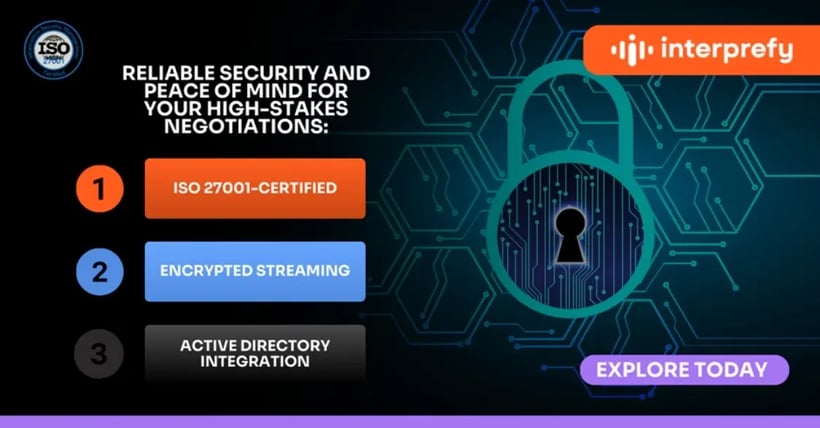
You are trusting a provider with more than language delivery. In many cases, you are trusting them with board-level conversations, strategic updates, public-facing events, and communications that carry legal, commercial, or reputational weight. So, security, resilience, and operational readiness should be part of the buying decision from the beginning, not left until procurement review.
Interprefy is designed for organisations that need enterprise-ready support, including regulated and security-conscious environments. That matters because credibility is not just about what a provider can do. It is also about how reliably and responsibly they do it.
7. What Proof Do I Have That This Partner Will Deliver Well In Practice?
By this stage, you are not looking for more claims. You are looking for proof.
That proof can take different forms: customer testimonials, repeat business, strong project support, on-site delivery experience, and evidence that the provider communicates clearly before, during, and after the event. In other words, you are looking for signs that the partnership will work in practice, not just in a sales conversation.
This is often where the final decision is made. Two providers may appear similar on paper, yet the difference becomes clearer when you look at how they support clients in real conditions. Do they stay responsive? Do they help your team feel prepared? Do they provide the right set-up, communication, and operational oversight when it matters most?
With Interprefy, that proof comes from more than platform capability alone. The model combines interpretation services, AI speech translation, live captions, and professional support in a way designed to feel clear, steady, and well managed. It is also reflected in customer experience, where buyers often point not only to pricing or features, but to the quality of communication, on-site support, and overall confidence in delivery.
That is an important distinction. A provider may meet your technical requirements. A partner gives you enough confidence to choose them.
Would like to know what our customers think?
Read our Customer Success Stories
Conclusion
In the end, choosing a language interpretation partner is not only about comparing features or pricing models. It is about finding a partner that can support your organisation with the right mix of expertise, technology, accessibility, and operational guidance, whether you need support for one event or an ongoing multilingual programme. If you want multilingual communication to feel clear, well managed, and reliable from the start, the right questions will help you make a stronger decision.
Looking for a language interpretation partner you can rely on?
Tell us about your meetings or events and our team will help you find the right interpreting setup and technology to make them a success.


 Download from the App Store
 Download from Google Play
 More download links