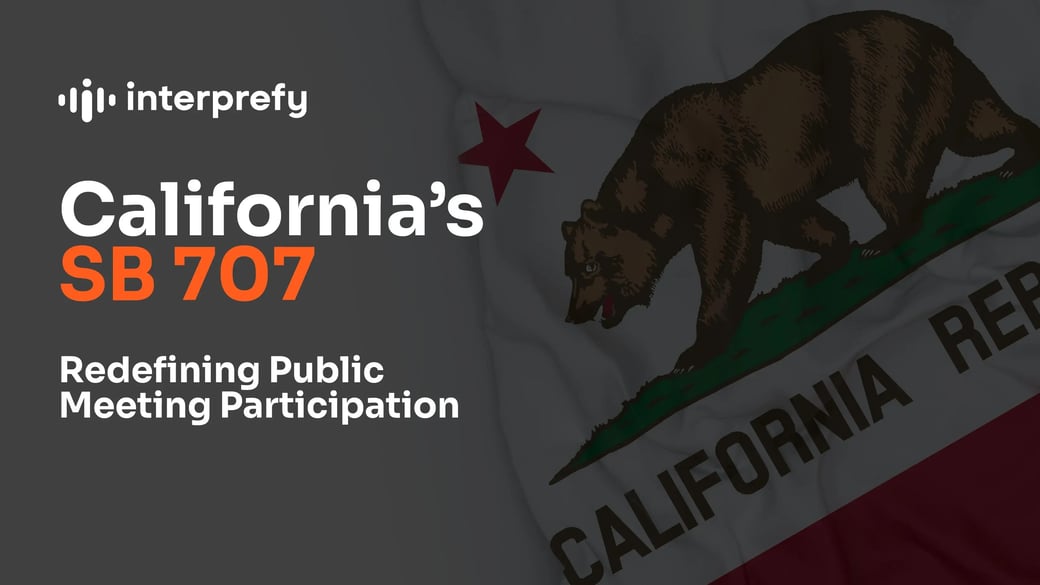
On 3rd October 2025, California Governor Gavin Newsom signed Senate Bill 707 into law. It quietly amended several sections of the Government Code. No fanfare. No viral headlines. But for any organisation involved in delivering, advising on, or participating in California's public meetings, this legislation matters more than most people currently realise.
SB 707 reframes what a "public meeting" actually means in the modern era. And for enterprise leaders working with public sector bodies, or operating within regulated environments that mirror these standards, understanding its requirements is not optional reading. It is the kind of legislation that reshapes procurement decisions, compliance frameworks, and communication infrastructure for years to come.
In this article
- What SB 707 Actually Requires
- Why This Is More Than a Compliance Checkbox
- The Multilingual Dimension Nobody Is Talking About Yet
- What SB 707 Good Implementation Looks Like
- How Interprefy Can Help Your Agency Meet SB 707 Mandates
- The Broader Signal for Enterprise Leaders
What SB 707 Actually Requires
At its core, SB 707 amends California's Ralph M. Brown Act, the foundational law that has governed open public meetings for local government agencies since 1953. The Brown Act already required meetings to be open and accessible to the public. SB 707 updates that obligation for a world where "being present" no longer necessarily means being in the room.
Starting 1st July 2026, eligible legislative bodies, a term covering city councils, county boards, school boards, and a wide range of other local government entities across California, will be required to offer the public the ability to attend all open and public meetings via a two-way telephonic service or a two-way audiovisual platform. The key word here is "two-way." This is not about broadcasting a meeting. It is about enabling genuine, interactive participation from people who are not physically present.
The bill runs through to 1st January 2030, giving it a defined window in which to operate, though the expectation among policy observers is that these provisions will be extended or made permanent as they become normalised.
In addition to the participation requirement, eligible bodies must also:
- Approve a formal policy regarding disruption of telephonic or internet services during meetings, before 1st July 2026
- Take specified actions to actively encourage residents to participate in public meetings
- Comply with defined procedures when technical disruptions do occur, including recessing open sessions for at least one hour and making a good faith attempt to restore services
The legislation also permanently extends an exception related to internet-based social media platforms, allowing members to engage in separate conversations on those platforms without triggering the prohibition on serial communications, provided certain conditions are met.
Why This Is More Than a Compliance Checkbox
It would be easy to read SB 707 as a bureaucratic tidying exercise. It is not. It represents a deliberate statement about who public governance is for.
California's population is one of the most linguistically and geographically diverse in the United States. Millions of residents cannot easily attend in-person meetings because of work schedules, transport limitations, caring responsibilities, or disability. Many more do not feel confident participating in formal settings where English is the dominant language of debate.
By mandating two-way remote access, SB 707 is effectively saying that the ability to participate in civic life should not depend on your postcode, your shift pattern, or your mobility. That is a significant political commitment, and it comes with real implementation demands.
For the organisations responsible for delivering these meetings, the question quickly shifts from "do we need to comply?" to "how do we actually do this well?" A low-quality telephonic dial-in that nobody can hear is not the same as genuine participation. A video platform that crashes during a contentious vote is not compliance in any meaningful sense. And a meeting that is technically accessible in English only is still excluding a significant proportion of the community it is supposed to serve.
The Multilingual Dimension Nobody Is Talking About Yet
Here is where the conversation starts to get interesting for enterprise leaders in the communication technology space.
SB 707 does not explicitly mandate multilingual access. But it sits within a broader regulatory and social context that makes the language question unavoidable. California has no official state language. Roughly 44% of Californians speak a language other than English at home. Title VI of the Civil Rights Act already requires recipients of federal funding, which includes the vast majority of local government bodies, to provide meaningful access to people with limited English proficiency.
When you combine a legal obligation for two-way remote participation with an existing civil rights framework around language access, the logical conclusion is clear. A public meeting that is technically "accessible" online but only conducted in English is still failing a meaningful portion of the public it serves.
For technology providers and enterprise leaders advising public sector clients, this is the conversation to be having right now. Not after July 2026. Not when the first complaint is filed. Now, during the planning and procurement phase, while there is still time to build language access into the infrastructure rather than bolt it on afterwards.
Real-time interpretation, whether provided through simultaneous human interpreters or AI-assisted tools, is increasingly mature and deployable at scale. The question is not whether the technology exists. The question is whether organisations procuring public meeting platforms are asking the right questions about it.
What SB 707 Good Implementation Looks Like
Compliance with SB 707 at the bare minimum level means having a dial-in number and a video link. But organisations that approach this thoughtfully will be thinking about several dimensions simultaneously.
Reliability and redundancy. The bill explicitly requires a response plan for technical disruption. That means the platform choice cannot simply be the cheapest option that technically works most of the time. Resilience needs to be built in, and the disruption policy needs to reflect actual operational practice, not aspirational language.
Related:
How Interprefy’s Architecture Protects Against Single-Provider Failures
Accessibility beyond connectivity. Two-way participation means members of the public should be able to speak, not just watch. That has implications for moderation, for meeting flow, and for the skills of meeting facilitators who may not have managed hybrid public meetings at scale before.
Language access as standard. As noted above, the civil rights context around language access does not disappear because a meeting moves online. If anything, the remote format creates new opportunities to deliver interpretation more efficiently, without the logistical overhead of in-room language provision. Organisations that embed this from the start will be significantly better positioned than those who treat it as an optional upgrade.
Documentation and audit trails. Public meetings are matters of record. Any platform used must support the kind of documentation and archiving requirements that governance bodies operate under. This is not a trivial technical requirement.
How Interprefy Can Help Your Agency Meet SB 707 Mandates
Meeting the letter of SB 707 is one thing. Meeting its intent, genuine, inclusive, two-way public participation, is another. Interprefy is built for exactly that gap.
Our platform delivers real-time interpretation and multilingual communication infrastructure that integrates directly with the audiovisual and telephonic systems your agency will need to deploy by 1st July 2026. Whether your meetings run on Zoom, Microsoft Teams, Webex, or a bespoke public sector platform, Interprefy works within your existing setup rather than replacing it.
Here is what that looks like in practice for agencies navigating SB 707 compliance:
Remote human interpretation, live translation and captions. California's linguistic diversity is not a footnote. For agencies serving communities where Spanish, Cantonese, Tagalog, Vietnamese, Korean, and many other languages are widely spoken, language access is what meaningful participation actually requires.
Interprefy gives agencies access to over 6,000 language combinations, delivered by professional human interpreters or AI-assisted tools, so residents can engage in any language without compromising on speed or accuracy. Live captions run simultaneously, ensuring that deaf and hard-of-hearing residents, as well as those following in a second language, can keep pace with the conversation as it happens rather than working from a delayed or incomplete record.
Real-time multilingual access. Residents can join from any device with an internet connection, whether that is a phone, a laptop, or a tablet, and access live interpretation or captions without needing to download specialist software or attend in person. For many community members, that flexibility is the difference between participating and being shut out entirely.
Seamless integration with your existing setup. Interprefy is designed to work with the platforms and equipment your agency already uses, whether that is Zoom, Microsoft Teams, Webex, a hardware AV system in a council chamber, or a hybrid combination of all of these. There is no need to replace existing infrastructure. Interprefy layers in, connecting interpreters and captions to your existing meeting environment without requiring a bespoke technical overhaul for each venue or meeting format.
Post-event recordings and transcripts. Public meetings create a legal record, and Interprefy makes sure that record is complete and usable. Agencies can access recordings in edited or unedited form, choose the format that suits their archiving requirements, and, critically, receive transcripts that are translated into other languages rather than dubbed. That distinction matters: translated transcripts preserve the accuracy and searchability of the original exchange in a way that dubbing simply cannot. Whether you need a full verbatim record or a clean edited version for public publication, the options are there.
Quality interpretation that works within your budget. Professional-grade interpretation does not have to mean prohibitive cost. Interprefy is built to flex around your agency's size, meeting frequency, and available resources. AI-assisted interpretation delivers accurate, real-time output at significantly lower cost for high-volume or routine meetings, while professional human interpreters can be deployed for sessions where accuracy is particularly critical. Many agencies use both, depending on the meeting type. Pricing is based on actual usage, so a smaller city council pays accordingly, and a larger county with complex multilingual requirements can scale up without switching platforms or renegotiating from scratch. Quality, reliability, and support remain consistent regardless of the tier.
Disruption resilience. The bill requires agencies to have a formal policy for handling technical failures during meetings. Interprefy's infrastructure is built with redundancy in mind, and our team can support your agency in drafting operationally sound disruption protocols that reflect how the platform actually behaves under pressure.
Scalable across your agency portfolio. Whether you are running a single city council or managing compliance across a county with multiple boards and commissions, Interprefy scales to match the volume and variety of your meetings without requiring a bespoke technical setup for each one.
Compliance deadlines have a way of arriving faster than procurement cycles move. If your agency is beginning to plan for SB 707, the time to assess your language access infrastructure is now, not in the spring of 2026.
The Broader Signal for Enterprise Leaders
SB 707 is a California law. But it reflects a direction of travel that is visible across public administration globally. Hybrid participation, remote access, and language inclusion are converging as requirements rather than nice-to-haves.
The pandemic accelerated public tolerance for digital meetings. Post-pandemic, the expectation that institutions would simply revert to in-person-only formats has not held. Constituents, employees, and stakeholders have become accustomed to the option of remote participation, and the political cost of removing it has made legislators reluctant to do so.
For enterprise leaders who sell into, advise, or operate within public sector environments, this creates a durable opportunity. The organisations that will serve this market well are not those that offer a videoconferencing tool with a dial-in option. They are those that offer end-to-end communication infrastructure that treats language access, participation quality, and technical resilience as core features rather than premium additions.
SB 707 is, in its own modest way, a case study in what happens when digital inclusion moves from aspiration to obligation. The organisations preparing now are the ones who will be trusted partners when the clock runs out on 1st July 2026.



 Download from the App Store
 Download from Google Play
 More download links