

Multilingual professional interactions demand clarity, not just connection. As organisations operate across markets, cultures and languages, dependable multilingual communication has moved from optional to indispensable. Whether you are running hybrid conferences, executive town halls, investor briefings or public sector hearings, the question isn’t just “Can we translate?” - it’s “Did accessibility feel like a checkbox or a human experience?”
This is the decision framework that event organisers need in 2026: one that distinguishes between platform-native live translation and specialised interpretation tools, explains where each fits, and lays bare the latest innovations from Google Meet, Zoom, Webex and Microsoft Teams - alongside the enterprise-ready capabilities of Interprefy.
It's time to make a decision that will lead you through the path of accessibility, compliance, clarity, and understanding or leave your audiences and teams undecisive and your business at risk.
At the heart of this framework is a simple idea: clarity in every moment enables confidence in every decision.
Understanding Platform-Native Live Translation
Over the past year, major conferencing platforms have leaned heavily into AI-powered live translation capabilities:
-
Google Meet is deploying Gemini-powered real-time speech translation, initially between English and Spanish with plans to expand to Italian, German and Portuguese, preserving vocal tone and expression.
-
Zoom continues to enhance its AI Companion and translation workflows, integrating advanced AI across third-party platforms such as Microsoft Teams and Google Meet, even as it expands productivity-focused AI functions beyond language (e.g. automated insights and agentic retrieval).
-
Webex supports real-time translated captions that automatically translate speech into caption text during meetings and webinars.
-
Microsoft Teams offers built-in AI translation for captions and chat alongside live translation previews, backed by Microsoft’s neural machine translation and enterprise compliance stack.
These developments are impressive and widen access to multilingual workflows — especially for small teams and low-risk internal meetings. They accelerate adoption of live AI translation and captioning and make translation accessible across familiar interfaces.
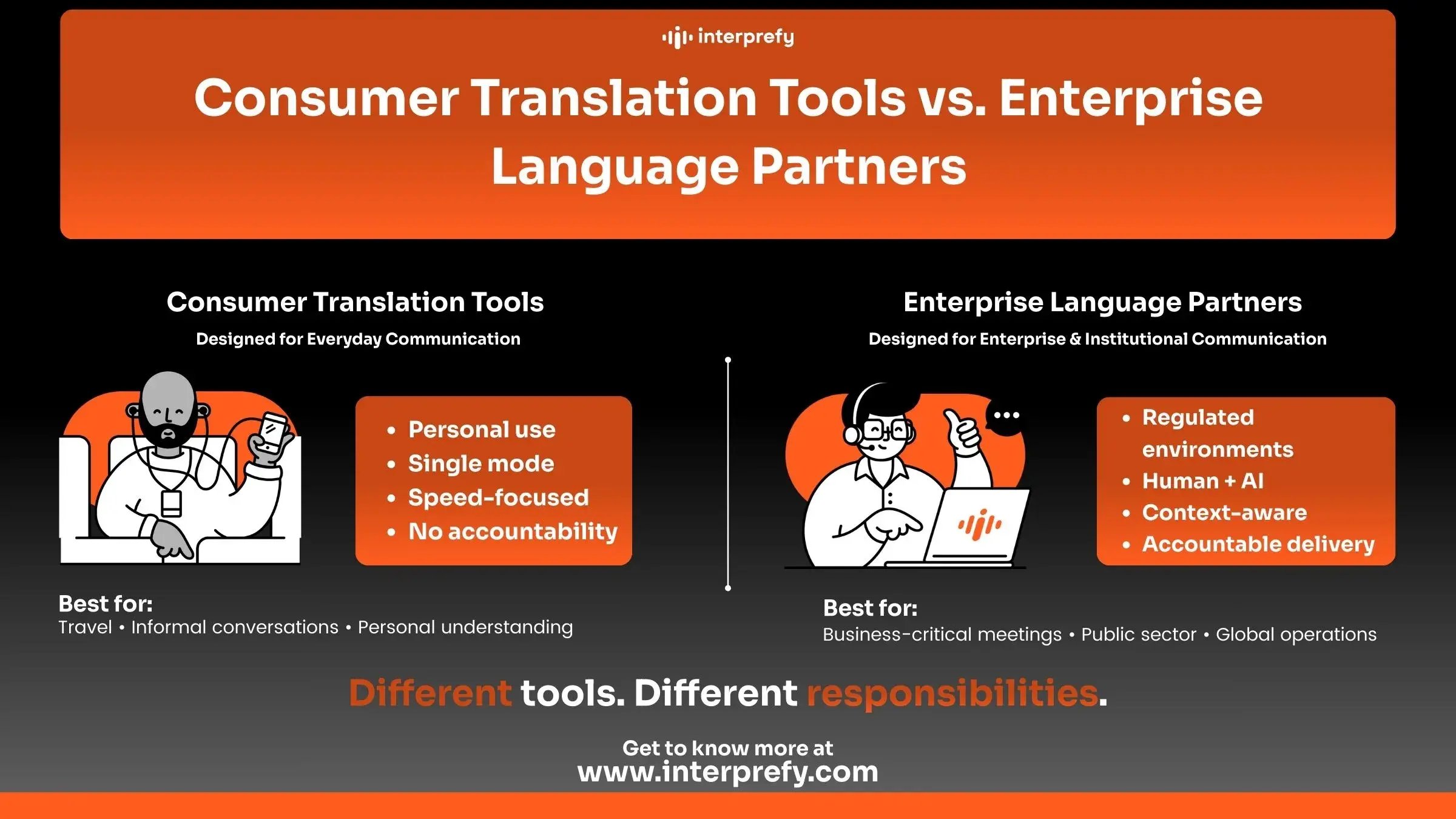
But there is a nuance that matters to decision-makers: platform-native translation features are built for convenience and broad accessibility, not enterprise clarity under pressure. That distinction matters most when communication isn’t just helpful — it is strategic.
What Specialised Interpretation Tools Offer Differently
Specialised interpretation platforms like Interprefy were built from the outset for professional multilingual communication at scale — whether online, onsite or hybrid. They embed both AI speech translation and professional human interpretation in a structured, accountable workflow rather than as an optional platform feature.
Unlike basic AI captions, specialised tools deliver:
-
Hybrid human + AI interpretation models that ensure nuance and accuracy in high-stakes contexts.
-
Governance and control, with interpreter selection, quality metrics, role-based access and reporting.
-
Flexible integrations and scalability across more than 80 platforms and event formats, with high uptime and redundancy.
-
Service and support, including project management, interpreter coordination and live monitoring, not just software.
For enterprise, public sector and regulated environments, these attributes are essential — not optional.
When Platform-Native AI Is “Good Enough” — And When It Isn’t
Platform-native AI translation excels in day-to-day collaboration: cross-language teams catching up with colleagues, or global support teams hosting quick multilingual check-ins. In these cases, the priority is accessibility over fidelity.
However, for events where outcomes matter — contracts, policy decisions, global launches — reliance on basic captions or language features exposes organisers to misunderstanding that can erode trust or compromise legal clarity.
In contrast, specialised interpretation platforms recognise that AI is a capability, not a replacement for accountability. Where nuance, cultural context and domain-specific terminology matter, professional interpretation is indispensable. It is this experience-over-technology mindset that differentiates tools engineered for clarity from tools designed for convenience.
Decision Framework: Three Essential Questions for Organisers
As you evaluate options, frame your decision around three strategic questions:
1. What’s the cost of misunderstanding?
If the cost is operational inconvenience, platform-native translation may be sufficient. If it could impact reputational trust, regulatory compliance, or strategic outcomes, specialised interpretation tools provide a safety net.
2. Who owns language quality?
Are you relying on an automated feature that you cannot govern or audit? Or do you have explicit control — from interpreter quality to terminology governance?
3. What experience are you designing?
Scale alone isn’t enough. Clarity must be consistent, reliable and measurable. Choose the solution that supports your experience goals, not just your tech stack.
Answering these questions moves your evaluation beyond feature lists to strategic intent — the difference between hoping language succeeds and knowing it will.
Comparison Table Appendix: Live Translation & Interpretation Tools (2026)
This side-by-side comparison highlights capabilities that matter most to decision-makers evaluating solutions today:
| Capability | Zoom / Teams / Google Meet / Webex Native AI | Interprefy (Specialised Interpretation) |
|---|---|---|
| AI-Powered Live Translation | ✔ Built-in caption translation (varies by platform) (Webex Help Center) | ✔ Enterprise-grade AI speech translation in 80+ languages (Interprefy) |
| Professional Human Interpretation | ✖ Not native; setup limited to platform channels | ✔ Certified interpreters with domain expertise (Interprefy) |
| Hybrid Human + AI Interpretation | ✖ No governance choice | ✔ Selective deployment for clarity and cost control (Interprefy) |
| Governance & Quality Control | ✖ Minimal controls, no SLA | ✔ Interpreter vetting, access control, usage reporting (Interprefy) |
| Integration Flexibility | ✔ Limited to native app features | ✔ Integrates with 80+ platforms, AV systems, mobile/web interfaces (Interprefy) |
| Service & Support | ✖ Platform support only | ✔ Dedicated project and live event coordination (Interprefy) |
| Security & Compliance (Enterprise) | ✔ Platform dependent | ✔ ISO-certified, GDPR-compliant interpretation workflows (Interprefy) |
| Custom Terminology & Tuning | ✖ Not enterprise supported | ✔ Custom vocabularies for event-specific terms (Interprefy) |
| Live Captions & Accessibility | ✔ Varies by platform | ✔ Enterprise captions with interpretation fallback (Interprefy) |
Final Thought: Clarity Enables Confidence
Choosing between platform-native AI translation and a specialised interpretation tool is not a question of technology versus cost. It’s about confidence through understanding.
When your event depends on clarity — whether for leadership communication, regulatory compliance, global audiences or strategic decision-making — interpretation must be designed, scaled and governed intentionally.
This framework, and the comparison table above, is your starting point. Let clarity guide your decisions — and give your organisation the confidence to act, decide and lead without misunderstanding.



 Download from the App Store
 Download from Google Play
 More download links