As organisations align priorities for 2026, one assumption is increasingly taken for granted: that AI translation has largely solved multilingual communication. In enterprise environments, this assumption rarely holds.
The rapid adoption of consumer-grade AI voice translation tools (such as Google Translate or Apple translate) has created the perception that professional meetings, events, and presentations can be interpreted automatically. These tools are widely accessible and effective for everyday communication. They are not primarily designed for enterprise contexts where accuracy, accountability, and trust are essential.
What often goes unexamined is how differently enterprise communication operates. Professional interpreting requires governance, accountability, and real-time risk management — but also the ability to match the right interpreting approach to each interaction. Some situations demand certified human interpreters, others benefit from AI-driven scale, and many require a combination of both. These are requirements that go well beyond what consumer translation tools are built to provide.
When communication carries legal, financial, reputational, or societal consequences, the difference between consumer AI speech translation and enterprise-grade interpretation built for regulated environments becomes decisive.
Understanding that difference is essential for organisations that need clarity, confidence, and trust in every moment.
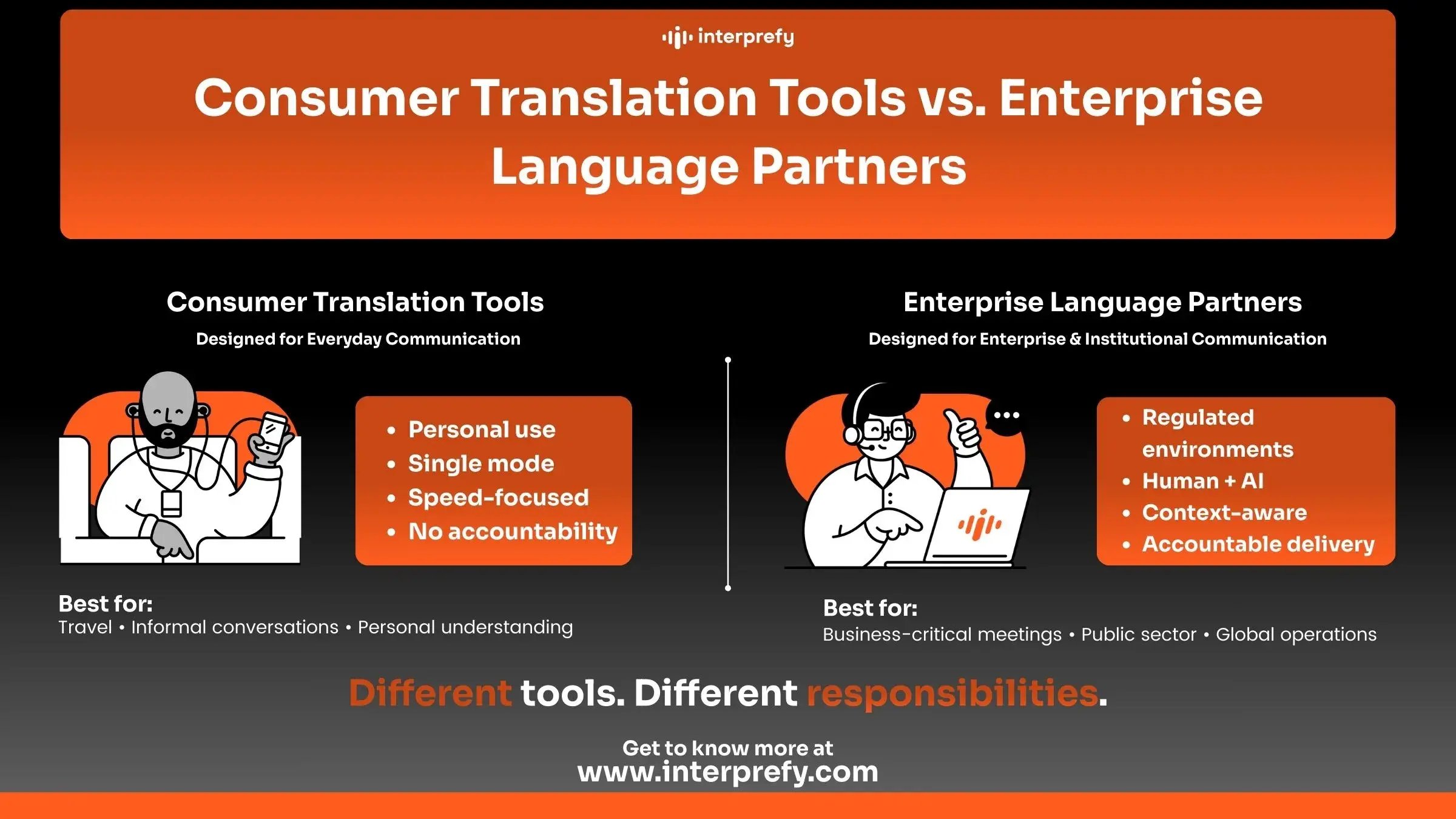
Consumer AI Translation: Designed for Convenience, Not Consequence
Consumer-grade AI translation tools are designed for convenience and speed. They use advanced machine learning and large language models to generate near-instant translations of text or speech. These tools are effective for general understanding, informal interactions, and quick cross-lingual assistance; for example, translating an email draft, a social media post, or day-to-day conversation.
AI translation often handles contextual meaning better than earlier automated systems by analysing full sentences and paragraphs rather than isolated words. However, even the most advanced AI systems can struggle to replicate intentional nuance, stylistic choices, or industry-specific terminology accurately across a wide range of contexts.
Crucially, consumer AI translation tools are optimised around probability, not accountability. They aim to produce the most statistically likely output, without understanding the broader organisational, cultural, or regulatory context in which communication takes place. As a result, industry-specific language, legal phrasing, and speaker intent may be simplified or lost.
Most importantly, consumer AI translation tools typically do not provide contractual accountability for outcomes. They are designed for general-purpose use and rarely offer the governance frameworks, service-level commitments, or transparency required in technical or high-pressure enterprise environments. For organisations operating at scale, this creates a fundamental mismatch.
Enterprise Human Interpretation: Precision, Context, and Accountability
Enterprise and high-stake interpretation services operate within a different domain. Professional interpreters remain an indispensable resource for enterprises and institutions because they are trained to manage context — including cultural subtleties, audience dynamics, and specialised terminology — across sectors such as finance, government, healthcare, and law.
In these settings, interpreting goes far beyond word-for-word translation. Interpreters are responsible for conveying intent, tone, and nuance so that messages are understood as intended. This capability is essential in board meetings, negotiations, regulatory proceedings, and diplomatic exchanges, where misunderstanding can directly affect decisions, compliance, or reputation.
Just as important is accountability. Enterprise interpretation services are delivered within structured frameworks that include secure platforms, confidentiality standards, service-level commitments, and professional oversight. Organisations know where responsibility sits and can rely on interpreting models designed specifically for high-stakes communication.
Trustworthy AI and Secure Communication Infrastructure Designed for Enterprise
Enterprise environments demand not only accuracy, but also trustworthiness, security, and compliance. Many consumer AI translation tools operate on general-purpose cloud infrastructures with limited options for enterprise-grade data governance, control, or auditability. This can raise concerns for organisations operating in regulated or confidential communication environments.
By contrast, AI voice translation offered by enterprise language solutions prioritise secure data handling, compliance with privacy standards, and controlled access to sensitive information. AI is used as infrastructure to support reliability, consistency, and scale - while responsibility remains clearly defined.
In enterprise-focused language services, AI is applied with intent and restraint. It supports platform reliability, quality assurance, and scalability across global events, while keeping professional interpreters central to critical communication moments. AI captioning with human quality assurance allows organisations to meet growing expectations for accessibility and inclusion without sacrificing reliability.
This reflects a core principle of Responsible AI: technology should support scale and consistency, while accountability, judgement, and trust remain clearly human-led.
Why AI + Human Interpretation is the New Enterprise Standard
Access to both AI and human interpretation changes how organisations manage multilingual communication. Rather than relying on a single interpreting mode across all situations, enterprises can apply the right interpreting approach based on context, risk, and scale.
Responsible AI frameworks only become operational when human expertise is built into the delivery model. Human oversight transforms ethical principles such as inclusivity, fairness, and respect from abstract commitments into everyday practice - through quality assurance, escalation paths, and professional accountability. This is fundamentally different from using standalone translation tools designed for individual, informal use.
For enterprises with global operations, this hybrid AI + human interpretation model provides resilience. AI enables speed, volume, and responsiveness, while human interpreters mitigate risks such as hallucinations, bias, loss of nuance, or contextual misinterpretation. In accessibility and language access use cases, pairing AI for captioning and scalability with human interpretation and quality control allows organisations to scale inclusive communication without compromising reliability.
Crucially, this approach aligns with how enterprises and institutions actually buy and deploy technology. Procurement teams are no longer asking whether AI is involved. They are asking how different interpreting modes are governed, how quality is assured across use cases, and where accountability sits when communication matters.
Why This Distinction Matters Now
At the start of the year, it's important for organisations to align strategy, reaffirm mandates, and sharpen how they present themselves globally. In high-stakes environments, enterprise and professional interpretation deliver a level of confidence that general-purpose consumer tools are not designed to provide: clarity to act, decide, and lead without misunderstanding.
Understanding the difference between consumer AI translation and enterprise, high-stake interpretation clarifies why specialised language partners exist - to enable organisations to communicate globally with confidence, accuracy, and trust.
In a world where communication increasingly defines outcomes, “good enough” translation is rarely good enough.


 Download from the App Store
 Download from Google Play
 More download links